
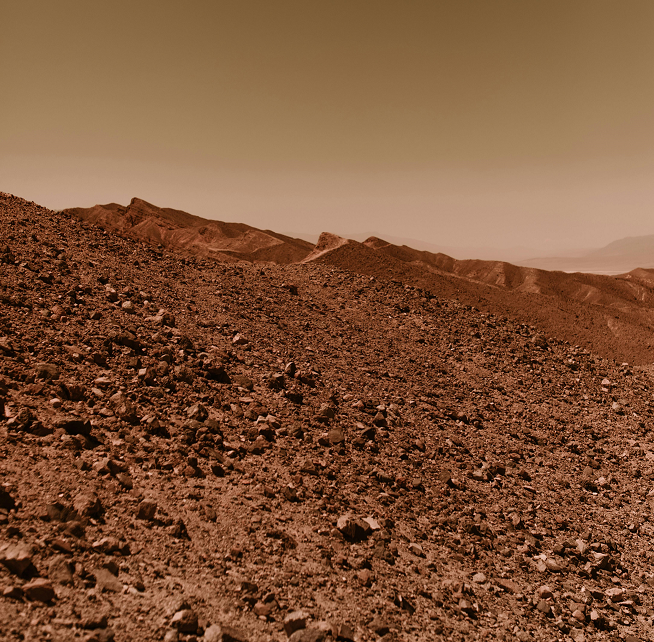
Scientists have just made a fascinating discovery on Mars: a new mineral called ferric hydroxysulfate. The name is a mouthful, but the implications it brings are exciting.
By Nicolae Bochis
This particular mineral hints at a watery, chemically active past on the Red Planet. And this time, it wasn’t the rover that made the discovery, but a team of researchers from the SETI Institute who analyzed the data gathered by the Mars Orbiter (which celebrated 15 years of accomplishments a few years back) high above Mars.
Once the data from the Mars Orbiter was gathered, scientists used a technique to analyze the light reflecting off the planet’s surface. This technique, called spectroscopy, helps us identify the chemical makeup of minerals from far away. That’s one of the methods used to estimate what distant planets are made of. That said, once the results were in, the scientists realized they were looking at something new: ferric hydroxysulfate, a mineral never seen on Mars before. So, why does this matter? This particular mineral forms in the presence of water, iron, and sulfur. All these ingredients suggest that Mars once had the right conditions for chemical processes similar to those on the early days of Earth. That means that perhaps Mars was once capable of sustaining life.
The mystery
The discovery of the ferric hydroxysulfate (Fe3+SO4OH) on Mars was the result of years of detailed research led by Dr. Janice Bishop and her team at the SETI Institute. Their work focused on analyzing a complex and geologically rich part of the planet, known as the Valles Marineris, a network of canyons and valleys near the Martian equator. The team used an instrument called CRISM (Compact Reconnaissance Imaging Spectrometer for Mars), which analyzes how sunlight reflects off the planet’s surface.
While examining the data gathered by CRISM, the scientists noticed unique light signatures in two particular regions of the canyon system: the Juventae Chasma and Aram Chaos. To better understand what they were looking at, the SETI researchers compared the data from Mars with minerals on Earth that form in acidic, water-rich environments. This comparison helped them identify the match. They were looking at a previously undetected mineral on Mars, ferric hydroxysulfate.
The common sulfates found on Mars typically form when minerals interact with sulfur (and sometimes water) under acidic conditions. However, ferric hydroxysulfate also requires oxygen and temperatures above 100 degrees Celsius, which is much hotter than the surface of Mars. That means that the main culprits for the sulfates’ development are volcanic and geothermal activity on the planet. That leads to the conclusion that the alteration in Mars’ minerals happened within the last 3 billion years, in the so-called Amazonian period. The research was published in the science journal Nature on August 5, 2025.


