
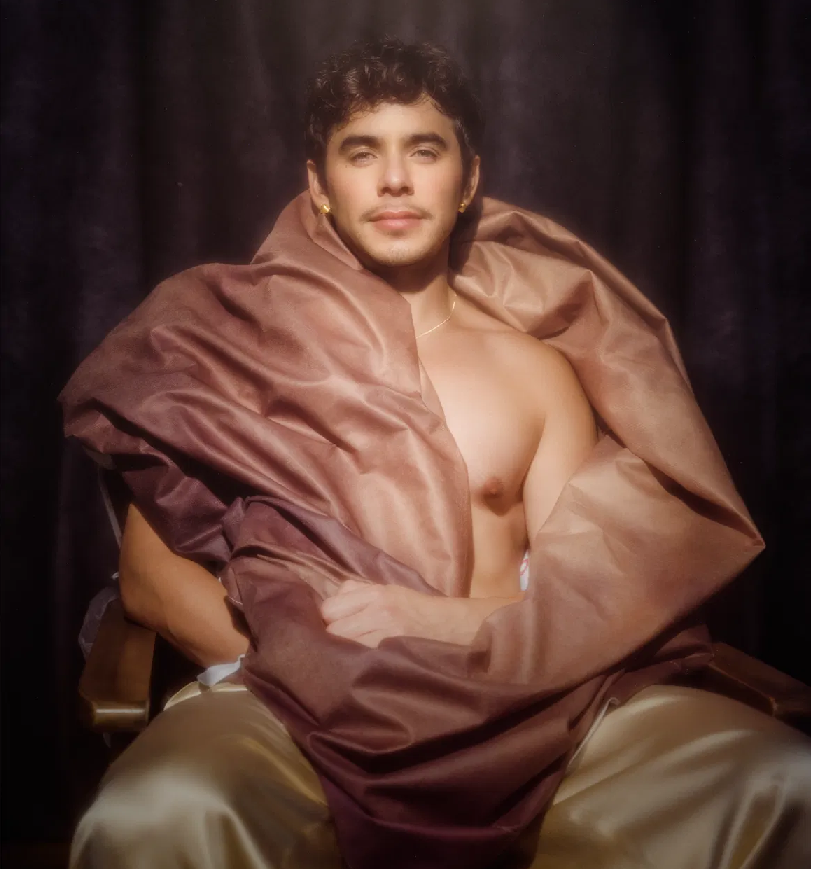
EXCLUSIVE: David Archuleta on how he escaped a gaslighting church and domineering dad to find his queer community.
Photo Credit: Joseph Adivari
By Cameron Scheetz
During one of his shows this past holiday season, David Archuleta was just settling into a more down-tempo Christmas ballad when a man in the audience began shouting, “Yaaaaaasss! Yaaasss, we love it!”
“I was so thrown off,” the singer-songwriter recalls to Queerty with a laugh, shaking his head. “I’m like, ‘this is not the setting, nor the song for that.’”
Though the American Idol and Star Search alum has been performing for adoring fans since he was a tweenager, it’s fair to say that lately he’s been drawing in far different crowds, ever since he came out as queer in 2021 and stepped away from The Church of Jesus Christ of Latter-Day Saints—the church he was raised in—two years later.
In other words, the gays are a little more boisterous at concerts than the Mormons.
That’s just one of the many realizations Archuleta’s come to in the past few years. After a lifetime of adhering to the strict codes of the LDS and struggling to reconcile that with his sexuality, he had a personal epiphany that allowed him to understand he could embrace his queerness and be loved by God. But when he tried to reason with high-ranking Mormon officials that there was a path for the Church to do the same—not just for himself, but for thousands of others like him—they ghosted him.
“They’re like, ‘We don’t want to hear it because it challenges our foundation,’” he says of the Church’s response to his pleas. “I’ve been there, I get why that’s a scary thing. But it did get to a point where, if I didn’t shake things up, it was gonna collapse anyway. So I did, and it all came down, but it was for the better because I was able to build a new foundation.”
Now, standing firm on solid ground, Archuleta’s ready to share what he’s learned in his new memoir Devout: Losing My Faith To Find Myself (now available via Simon & Schuster/Gallery Books, and the latest pick in the Queerty Book Club), chronicling his journey from closeted teen to Mormon poster boy to, finally, becoming the artist he’s always wanted to be.
It’s the kind of tell-all packed with juicy behind-the-scenes stories you might expect from someone who’s lived a life in the spotlight, but it’s also a harrowing yet ultimately empowering account of his road to self-acceptance. And it just might be able to kickstart some important conversations at the intersection of queerness and religion.
“I hope that this book puts the positive kind of pressure on my church community that I grew up in and loved so much—they raised me to be a compassionate, understanding person,” Archuleta remarks, hoping maybe they can practice what they preach for once instead of turning away out of fear. “I’m like, ‘Wait, can you hear my story first?’”
The Father, The Son…
There’s a version of David Archuleta’s story you’ve probably heard before. Back in 2008, the shy 16-year-old from suburban Utah made his first appearance on American Idol Season 7, telling Ryan Seacrest about how he overcame vocal paralysis before wowing the judges—and the millions watching at home—with a soulful rendition of “Waiting On The World To Change.”
With raw talent and a wholesome Mormon appeal, he captured the hearts of America, which carried him all the way to the finale. And even though he became the runner-up to rock radio-ready David Cook, he still went on to have a chart-topping single in “Crush,” hit albums, and world tours.
In 2010, Archuleta recounted his incredible rise to stardom with his first memoir, Chords Of Strength: A Memoir Of Soul, Song, And The Power Of Perseverance, but there was just one problem—the same problem that had been hanging over nearly every step of his career thus far: it was pretty much entirely dictated by his father.
During his time on Idol, rumors began to swirl that sweet David had a domineering stage dad, Jeff, who was indeed causing drama backstage as he attempted to control everything his son said, did, or sang on the show. And it didn’t stop there. As he reveals in Devout, Archuleta spent years following his father’s orders—or being reprimanded every time he dared speak up for himself.
Things eventually got so bad between them that he had to cut dad out of his life completely, and the two barely spoke for quite some time. It wasn’t until Archuleta came out publicly that Jeff reached out again, and though he braced for the worst, he was surprised to hear his father say how proud he was, for the first time in a long time.
“He always looked at me as a superhuman,” Archuleta says of his father, “because, according to Mormon standards, I was: I was very obedient, I was successful with my career, and I was placed on this pedestal, so everyone would look at me as the example. And I think my dad didn’t look at me as a normal human either, because I was supposed to be better—I was supposed to be this example.”
He continues: “But when I came out, it really did change the dynamic between us. I think it helped him realize we didn’t have to keep trying to put on these fronts, that he could be a broken person. During Idol, he put on his own front—like, ‘we have the perfect, happy Mormon family, and we can’t let people know about our problems.’ I think to be able to say, ‘I’m letting go of this illusion,’ it enables other people around you to do the same, to feel the freedom to do so.”
… And The Holy Ghost
Getting his dad to fully see and accept him was one thing, the The Church of Latter-Day Saints was another—this is, after all, an organization that chooses to refer to homosexuality as “same-sex attraction” because it’s viewed as an affliction, something “righteous” people could overcome.
Archuleta had devoted himself to proving he was righteous enough. Despite his successes post-Idol, when he turned 21, he volunteered to serve as a Mormon missionary in Chile for two years (where, ironically, he first acknowledged his sexual attraction to other men). And, because so much of the Church is centered around starting a family of one’s own, he’d later make multiple attempts at maintaining relationships with women, even getting engaged on three separate occasions.
But he just couldn’t shake or ignore what he was really feeling inside, and it was eating him alive.
During his last engagement, Archuleta remembers hearing from a Mormon friend who had caught her husband cross-dressing, prompting the man to retaliate and become abusive.
“It terrified me how much I could relate to the anger that her [now] ex-husband felt,” he admits. “I could feel that bitterness and hatred, all because I could never accept myself. I felt like I was on that path by continuously being told to suppress [my sexuality,] to act like it’s not there and look happy to everyone else. That was not worth it to me, and it was a big moment where I knew, ‘David, you’ve got to do something about this.’”
In the most intense depression of his life and on the brink of self-harm, Archuleta says it was “divine design” that led him to a one-on-one conversation with God where he finally understood it was okay to be gay, that God made him this way. Right then and there, he took that revelation to Instagram and hit post, courageously sharing it with the world.
For a while, it became his new mission to help the LDS community see what he sees, to change it from within. But no matter how high up in the Church he could take his appeal, he kept running into deadends.
“I was seeing the pattern, it comes from the top down,” Archuleta says. Even when it felt like he could find an empathetic ear from some of the most powerful apostles in the world, he noticed a reluctance to address the issue at hand—they could acknowledge it, yet refused to actually question the discriminatory beliefs that have been part of Mormonism from the very beginning.
“It was like, ‘I feel for you, but I can’t go there, because then I have to admit something’s wrong here that needs to be fixed, so I’m just going to pretend you didn’t say anything,’” he suggests, reading between the lines of what church officials repeatedly told him. “I didn’t say anything disrespectful, I didn’t make accusations against them…. but now I was threat to their faith and their connection with God. They basically said, ‘I’m feeling uncomfortable with what you’re bringing up, so I’m just going to pretend that you’re not even there anymore. So everything’s fine here in the church; look how happy everyone is.’ It was like gaslighting!”
Finding A New Kind Of Church
When David Archuleta officially left the LDS Church in 2023, his mother and other siblings followed suit, inspiring his powerful single “Hell Together” where he croons, “If I have to live without you, I don’t wanna live forever in someone else’s Heaven.”
And while he crucially still had that family support system, for this first time in life, there was no one—no demanding father, no restrictive religion—telling him how he should run his career, or who he should be. So, who was he?
“I was so used to shielding myself from everything, I didn’t know where to find friends, I didn’t know where to find community,” he admits. “I felt lost when I came out and left my church. So I really clung on to dating, because at least I could filter through people and have discernment.”
But Archuleta confesses it was difficult to find a healthy balance in his romantic life after decades of “extreme codependency,” finding that he’d often make his whole world revolve around whoever he was seeing at the time. He was so used to giving the entirety of himself to his religion—and before that, to his dad—that he was doing the same in these early relationships.
Funny enough, it was someone he had been dating that first introduced him to the culture around electronic dance music, or EDM. Though he’d been a fan of the genre for a while, he’d never been to a rave, so when he was convinced to check one out, it rocked his world.
“Seeing everyone just be free, opening up their spirits, letting themselves release any inhibitions and dance? I was in awe,” he remembers of his first rave. It was like church, with a few key differences: “I became hooked, because the people I met, they welcomed you, they were inclusive. It didn’t matter how you dressed, it didn’t matter what your sexuality was. You were just welcome to be there and interact and vibe to the music with everyone else.”
Eventually, Archuleta would come to find that same sense of belonging within the LGBTQ+ community, too, though it took some time to get over the nerves of being in queer spaces. He remembers the first gay event he “accidentally” attended—while still closeted—was to see his friend, former Glee star Jake Zyrus, at an NYC venue that happened to be a nightclub filled with drag queens. “I was like, ‘Why are they calling each other bitch?’ I was so confused,” he laughs.
Turns out, the gay language of sarcasm takes some getting used when you’re raised Mormon. “We don’t know how to always process it because the Church tells you you’re supposed to be honest and true,” he reflects. “And sarcasm can go against that, because you’re kind of lying… but you’re making a joke, and it’s supposed to be funny.”
So, the first queer event he ever willfully went to happened to be the 2023 Queerties Awards, where he was visibly nervous and overwhelmed among the crowd, yet still delighted to see so many familiar and friendly faces. The very next year he returned to the Queerties, though this time he felt much more at home, taking the stage to pay tribute to his friend and ally Paula Abdul with a show-stopping medley of her biggest songs.
“Just letting myself feel sensual on that stage, in front of all those people, was something I wasn’t used to—because Mormons, you’re not supposed to feel sexual at all.” Since then, he’s felt emboldened to incorporate that sensuality into his personal style and his own music, like his viral 2025 single “Crème Brulée,” a Sabrina Carpenter-esque fusion of food & flirtiness, with a spicy, dance-heavy music video, to boot.
“When you grow up in a higher demand religion, you’re constantly checking yourself, like, ‘Am I okay? Am I doing what I’m supposed to? Am I in an environment where it’s okay for me?’ And now I’m just like, ‘Okay, it doesn’t matter! You’re having fun; who gives a f*ck?’”
Come As You Are
This is definitely not the same “innocent Mormon boy” we saw take the stage of American Idol nearly 20 years ago, who wouldn’t even dream of thinking of a swear word. But that version of him isn’t completely gone, especially not that child who truly loved music, the way it could move him—and others. “I feel like now I’m finally getting to experiment with music the way I would have when I was a kid,” Archuleta adds with a smile.
And, sure, he might be drawing in different audiences these days—a louder, prouder crowd who feel free to be themselves in the inclusive environments he’s created—though he still wants his very first community to know that his music, his book, and his message can be for them, too.
“I would hope that people in Utah can still identify with me as an artist, just like they do with other artists, rather than solely through the religious tie,” Archuleta says. “I still have that shared experience with them, and I loved being a part of the church that I grew up in. Even though I left it, hopefully they understand why I had to, and why it was such a hard decision to make. I didn’t want to have to keep fighting for my place, as a queer person, when this was supposed to be my safe space.”
He continues: “Because of how we’re raised, I know a lot of people in the Church want to express that compassion and that acceptance to invite queer people in. But the religion gives them these strict parameters that don’t allow them to. So, I hope that this book challenges the LDS leaders to change that, to give their members the space to be the compassionate, welcoming people they’re meant to be.”
For David Archuleta, when he says “come as you are”—whether in church, an EDM rave, or one of his own concerts—he wants you to know he really means it. Even if you’re a little loud.
Next month, David Archuleta’s Devout: Losing My Faith To Find Myself is our pick for The Queerty Book Club in partnership with Allstora. Sign up before March 14 to join and receive a copy of the book; members will also get discounted access to other Allstora titles, a private space to chat with other readers, and occasional surprises from the authors themselves. Find more information here.
Source: https://www.queerty.com/exclusive-david-archuleta-on-how-he-escaped-a-gaslighting-church-domineering-dad-to-find-his-queer-community-20260217/


