
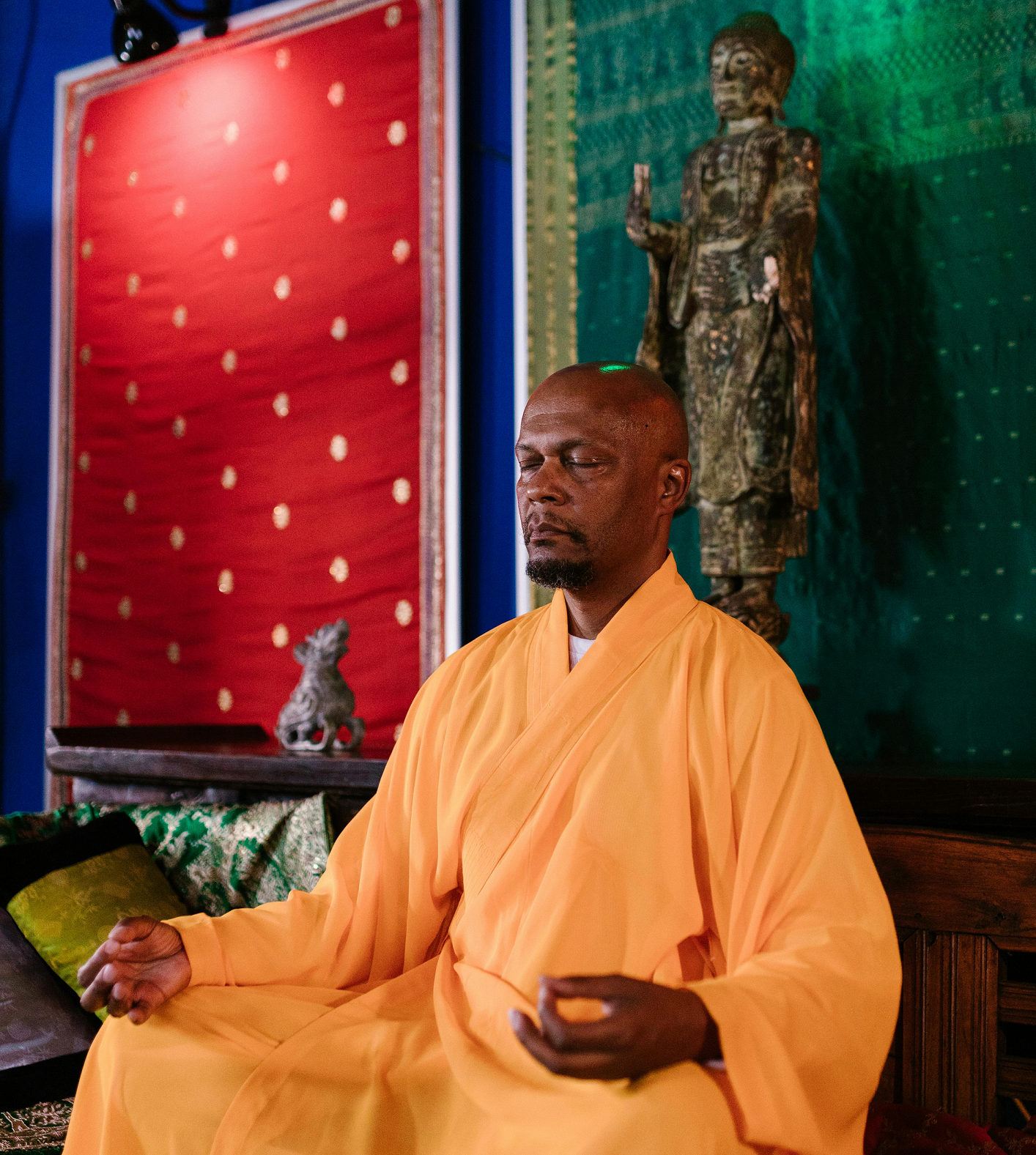
Panic attacks & worry plagued this gay man’s life. I’ve tasted all of the things on the buffet of life that queer hedonism offers for me, and yet that has not answered the question, “What am I?”
By Daniel Villarreal
When V. Joseph entered his late 30s, he started experiencing a midlife crisis, complete with anxiety, panic attacks, and an insufferable uncertainty about his life’s purpose. Joseph, who was living in the Bay Area of San Francisco, California, told LGBTQ Nation that he considered getting married and having kids, but like a lot of queer people, he felt that that “normal” and “heteronormative” life path was irrelevant to him.
“I’ve partied, and I’ve had all this crazy wild sex,” he continued. “I’ve tasted all of the things on the buffet of life that queer hedonism offers for me, and yet that has not answered the question, ‘What am I?’ That’s not enough, I need more.”
He didn’t need therapy so much as spiritual support, he said, so he considered Beat Generation writers who had inspired him earlier in his life – like bisexual poet Philip Glenn Whalen, gay poet Alan Ginsberg, and ecologist Gary Snyder, all three of whom helped popularize Buddhism throughout the U.S. during the 1950s and 1960s by writing about the impact of meditation on their lives.
Buddhism is over 2,000 years old and has many varieties, but all of them view suffering and dissatisfaction as inherent parts of life caused by longing for permanent material comforts and pleasurable sensory experiences. This suffering, Buddhism says, can be overcome through wisdom about the true nature of reality, ethical treatment of other living things, and the development of greater awareness and stillness through meditation.
He began meditating on his own at home, but he had trouble developing the habit. Soon, he realized that he needed a sangha, a group of fellow Buddhists, to help support his spiritual practice. So he began visiting the San Francisco Zen Center, one of the largest Buddhist communities outside of Asia.
Established in 1962 in a building that previously served as a residence for Jewish women, the center now welcomes thousands of practitioners and dozens of Buddhist monks and masters from around the world.
It holds a library decorated with Buddhist art and statues where visiting practitioners give “dharma talks”; a dining hall where humble vegetarian meals (often rice, tofu, and steamed greens) are served on long tables for mindful communal dining; a calming outdoor garden, courtyard, and rooftop space; and a large meditation hall filled with natural light and sitting cushions.
It’s in this hall that Joseph sits for the regularly scheduled 5:30 a.m. or 5:30 pm. zazen: long, open-eyed, seated meditation sessions facing a wall (to reduce visual stimulation) that form the heart of Soto Zen Buddhism – a tradition whose roots trace back all the way back to Siddhartha Gautama, the religion’s founder – which cultivates everyday mindfulness by practicing sitting quietly and letting thoughts and emotions pass without grasping or judging them.
Joseph said the practice, which he now does for at least 30 minutes once or twice a day, gives him a sense of spaciousness and interconnectedness. Being in a room with other zazen practitioners has instilled in him a sense of accountability, and he considers their company “intoxicating and invigorating.”
“The world of gay men [often] happens on this substance use axis: Either you’re at the bar or maybe you’re at an [Alcoholics Anonymous] meeting, but… a relationship with substances somehow is defining the space in which gay men are connecting,” Joseph said.
The coming-out journey that queer people go on, he said, involves coming to grips with the fact that one’s current life, identity, or labels don’t always fit with what’s happening inside their body in the present moment…. Meditation is an invitation to experience and feel that.
“So much of the version of me that used to go hang out at bars or whatever was this sort of flamboyant, loud, outgoing version, which is great, and it’s fun,” he continued, “but it’s really powerful to be with a community of people like this… We can always be quiet together and actually be a community of people where I don’t need to perform anything.”
When Joseph first visited the center, it was celebrating its annual Sejiki ceremony (also known as the “Festival of the Hungry Ghosts”), during which celebrants drum, shout, chant, and call forth spirits that embody the pain of insatiable craving, greed, and addiction.
An infamous hungry ghost, Joseph said, appears in the beloved 2001 Hayao Miyazaki animated children’s film Spirited Away in the guise of “No Face,” a dark masked creature who grows to giant proportions after devouring an entire banquet hall of food, but who remains enragingly unsatisfied, even as he tries to win over others’ affections by offering them worthless handfuls of fool’s gold.
“[Sejiki] is a ceremony about kind of investigating desire and need, and parts of us that are kind of wanting, and that was the day I showed up,” Joseph said. “It was powerful for me, because I think I was… suffering in a way that made me a bit of a hungry ghost.”
Over time, Joseph began visiting the center more often to help cook weekday-afternoon meals and to prepare for gatherings and talks. As he began attending more of its events, he acquainted himself with the center’s many other queer members, as well as with people who fly in from around the world just to visit.
Together in the dining hall, they silently get in line, retrieve their food, sit at tables, and wait until someone claps two wooden blocks together. Then they all recite a chant honoring the food’s origin, the nutrition it provides, the diners’ intentions, and the surrounding community.
“When I sit on the cushion this morning, it’s not for me, it’s for the benefit of everybody else in the world, so I can show up differently for the world.”
V. Joseph, a gay Buddhist man
“Then there’s this sort of joyful moment that happens after that, because it’s kind of a released feeling where everyone says, ‘Oh, good morning! Good afternoon!” Joseph said. “It’s like, ‘Oh, hello, we’ve been quiet for so long together,’ and now we sort of like release into conversation, and I love that moment… because there’s so many people there, I always end up meeting somebody new, I see my old friends… and I am continually surprised by the life stories people share with me over those meals.”
“It’s young people, it’s old people, it’s men, it’s women, trans, queer people,” Joseph said. “It’s like all walks of life are there, and people are pretty generous with telling pretty powerful life stories that are profound and funny and sad and all of the above.”
The center offers affinity sanghas for transgender Buddhists, BIPOC people, recovering addicts, and other groups; nature and outdoor retreats at its Tassajara Zen Mountain Center in Carmel Valley and Green Gulch Farm in Marin County; tea ceremonies; calligraphy practice; Butoh movement lessons; poetry nights; as well as a variety of in-person and online classes in topics ranging from dealing with chronic pain, practicing peace inside of prisons, and transforming fear and anger to lighter lessons in chanting, yoga, and understanding the songs of birds.
For Joseph, Buddhism has become intimately interconnected with queerness because he sees meditation as an invitation to experience and feel life as it is, without judgment, without labels, to see and accept what’s happening in this moment. The coming out journey that queer people take, he said, involves coming to grips with the fact that one’s current life, identity, or labels don’t always fit with what’s happening inside their body in the present moment.
While he first started meditating to gain peace of mind, Joseph (who is now in his 40s) said the practice has softened him and created more heart and headspace where he feels less reactive and impulsive. He calls this a “protective bubble” that gives him more time between what he experiences in the world and what he chooses to do next.
“Maybe I still do choose to be an as**ole,” he said, “but just having an extra 50 milliseconds is often enough for me to catch myself and be like, ‘You know, I don’t want to say that thing, I’m just going to stay silent, I’m just going to smile, I want to say something different that will bring us all back together.’ That extra little buffer gives me some time to just make different choices in what I say and what I do, and how I move through the world of people.”
“I’m no longer meditating for myself,” he said. “This is no longer a selfish practice. The reason, my reason for meditating, and the reason that a lot of practitioners have for meditating is I’m now meditating for everybody else.”
“When I sit on the cushion this morning, it’s not for me, it’s for the benefit of everybody else in the world, so I can show up differently for the world, and so that in the corner of the world that I have influence and control of, there’s maybe a little bit of peace and equanimity in this in this corner of the world I’m in. So there was a journey there from, ‘I’m in crisis, I need help,’ to ‘Something changed. Something softened, maybe I got that help,’ and now the practice is about something much bigger.”
Source: https://www.lgbtqnation.com/2026/05/attacks-worry-plagued-this-gay-mans-life-finding-buddhism-changed-everything/


