
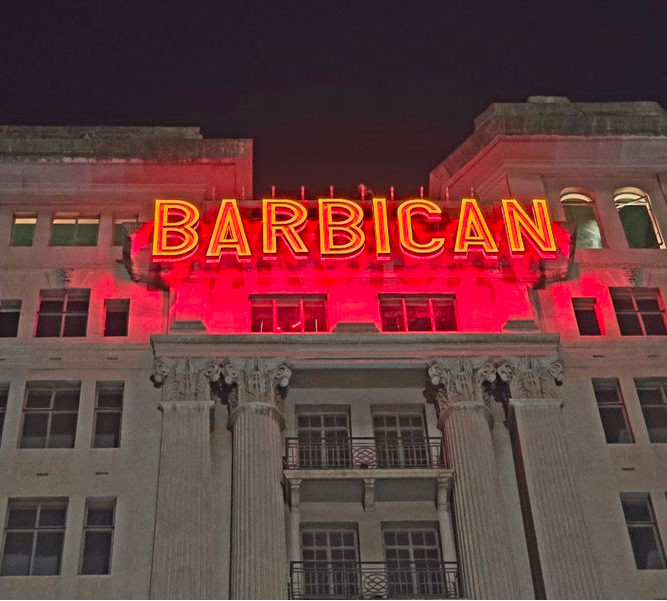
And the lights go on at the historic Barbican building.
By Bridget Hilton-Barber
A big new neon sign lit up the rooftop of the historic Art Deco Barbican building in Marshalltown last Friday night – a beacon of hope for the inner city’s creative economy.
A crowd of architects, artists, business owners, developers, activists, media and creatives gathered on the Barbican’s rooftop to celebrate the first phase of the building’s restoration and witness the symbolic switching on of the new Barbican neon sign. And it wasn’t just any sign, nor mercifully an LED screen; it was modelled on the original with vintage typography evoking glam and 1930s urban Americana.
The Barbican is on the corner of Helen Joseph and Rissik streets in Marshalltown, the city’s oldest intersection and home to its first ever traffic lights and it overlooks the City Hall and Rissik Street Post office. In 1929 the owner of this prime corner site, wealthy property developer HG Heimann commissioned the design by South African firm Obel and Obel.
From the rooftop, the diversity of architectural styles is unique to Jozi – it ranges from Colonial, Edwardian Baroque and Art Deco to Modernist, Brutalist, Futurist and Structural Expressionist.
It was exactly this surreal cityscape that drew Italian global property investor Michele Ciani to invest in Jozi at a time when few dared. While local developers wrote off the inner city, Ciani saw it as an irreplaceable piece of beauty. He bought the Barbican in 2020 and partnered with local heritage architect Brian Kent McKechnie – a longtime champion of the restoration and re-use of city buildings – to turn it into a creative hub, topped with a decadent penthouse with outrageous views.
“Jozi reminded me of Gotham City,” said Ciani. As a child, he was fascinated by superheroes and classic comic book cityscapes. It was love at first sight the first time he saw the Barbican. “I also fell in love with the urban energy of Jozi,” said Ciani. “You people are so layered, you don’t get this community feeling anywhere else in the world.”
Much like the city itself, the Barbican rose and fell. In 1931, the glam American-style eleven-storey Barbican was the tallest in the city. By the 90s, many iterations later, it was abandoned and vandalised. After a massive heritage preservation effort, Old Mutual bought the Barbican in 2010, put R20-million into stabilising it, yet it lay dormant for another decade.
|
Ciani said his vision was to develop the Barbican into a sustainable creative community and turn Marshalltown into a cultural hub. The result so far is a delightful mix. Bridge Books, an independent bookstore and coffee shop, is on the ground floor of the building and the middle floors house the studios of David Tlale Fashion Academy.
Source: Daily Maverick


