
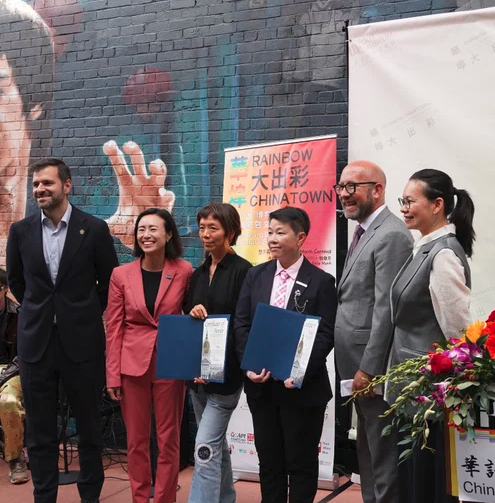
“Here’s the beautiful art that we create and imagine and contribute to the world.”
By Daniel Villarreal
San Francisco’s Chinatown doesn’t just have some of the city’s most unique markets, eateries, and architecture — it’s also home to the OUT Museum, the word’s first Chinese LGBTQ+ Museum.
Opened in May, the free museum currently has a one-room exhibition space that is only open on Saturdays and through a reservation on its website. Organizers hope to expand the space and hours in the years ahead, the Associated Press (AP) reported.
The museum’s opening exhibits included a two-person opera performance, a color-coded timeline showing the progress of China’s LGBTQ+ community throughout history, an interactive yarn exhibit allowing people to chart their own experiences with sexuality and gender, as well as mixed media art installations combining old photographs, heirlooms, keepsakes, and other objects.
The museum was the brainchild of Xiangqi Chen, a Chinese native who left China after the government began cracking down on LGBTQ+ activism. Her own queer activism flourished when she came to San Francisco on a visiting scholar visa in 2022. During her exhibition at the Asian Art Museum and residency at the Chinese Culture Center of San Francisco, she got “so many chances to connect with the local Asian American queer community and even the Chinatown community in general,” she told the AP.
She fundraised to open the museum, and it’s currently staffed entirely by volunteers.
Chen told KTVU that she wants the museum to inspire and educate and hopes it will help pull the local queer Chinese community together. She said she has been “100% moved” by the straight and queer Chinese immigrants who visit the museum to express gratitude for uplifting the LGBTQ+ Chinese voices; including a 60-year-old transgender man who immigrated to the US in the 1970s to get gender-affirming care, and a mother trying to connect with her gay adult son.
The museum’s Chinese-only website says it’s dedicated to “preserving queer creations, life trajectories, social movements, and cultural production within a Chinese-speaking perspective, re-connecting the art, documents, and stories of LGBTQ Chinese, Chinese immigrants, and diaspora communities,” and serving as a bridge for cross-regional queer experiences that links the life experiences of different generations, and “enables everyone in society to find understanding, dialogue, and resonance.”
Author and activist Helen Zia, a museum advisory board member, pointed out that the museum is particularly important since anti-LGBTQ+ sentiment has pervaded the Chinese communities, both in the US (where older and religious Chinese immigrants may harbor anti-LGBTQ+ feelings) and in mainland China, where the government sees LGBTQ+ activists as a subversive threat to state power.
“It’s a physical space to say that we exist… [and] we have beauty in our lives that comes out in the artwork that we do, the performances, the books that we write,” Zia said.
The museum helps other “see our humanity,” she added, “[Like,] here’s the beautiful art that we create and imagine and contribute to the world.”
Hong Kong artist Dixon Ngai told the AP, “Although we are not covered by traditional or mainstream media, we do exist, and I believe we will only continue to move forward.”
Source: https://www.lgbtqnation.com/2026/09/san-francisco-opens-worlds-first-chinese-lgbtq-museum-so-many-chances-to-connect/


