
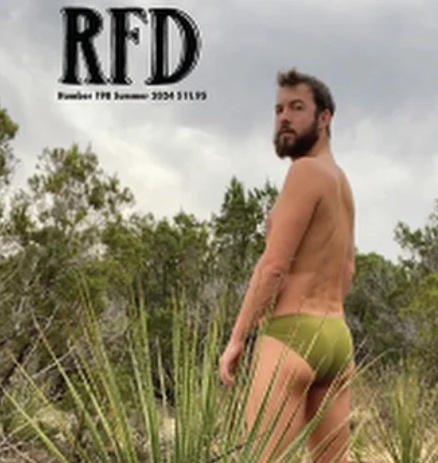
RFD stays small, moves slowly, refuses to chase clicks, & lets readers speak for themselves. Yet, it has endured for decades.
Oriol Poveda
Four times a year, Bambi Gauthier (58) and Matt Bucy (63) sit down together and make a magazine. This time, in White River Junction, Vermont, the word hanging over the issue they are assembling is “Crisis.”
The submissions have come from RFD’s readers: “Confessions of a Magical Negro,” “God’s Elect vs. Sluts and Sodomites,” “A Trumper and a Gay Man,” “The Ghost of Don’t Ask, Don’t Tell.” There are poems, essays, photographs, drawings, and pieces that resist easy categorization. One of them, a “Crisis Diary,” is mine. I have been reading RFD for years and, like almost everyone whose work appears in its pages, sent something in without knowing whether it would make the cut.
Nobody was commissioned to produce any of it. Nobody was paid. Now Gauthier and Bucy have to figure out how the pieces fit together. Gauthier handles most of the words. Bucy takes care of the visuals. Bucy is trim and animated, dressed casually in a T-shirt featuring a cartoon cat, while Gauthier, with his glasses and long gray beard, has something of the air of the archivist he is.
Their process is unusual. Until layout begins, Gauthier deliberately avoids looking at the visual submissions. Bucy, meanwhile, doesn’t really read the articles until he starts putting them on the page.
“Bambi brings me a pile of texts and says, ‘Here,’” Bucy tells me. “We just put it all in, and then we start looking at it, moving things around. It’s like a big puzzle.”
They flip through the nascent issue again and again. An image doesn’t feel right beside an essay, so they move it. A poem belongs somewhere else. Gradually, words and images begin to develop what Bucy describes as an emotional flow.
“I can’t say that it’s an intellectual process,” he says. “It’s more just feeling.”
The puzzle they are assembling is issue 207 of RFD, a quarterly that has been publishing since 1974, making it one of the longest-running queer publications in the world. But there is a bigger puzzle here, too. In an era when journalism is increasingly governed by scale, speed, algorithms and the endless competition for attention, how has a queer print publication with two principal editors, no salaries, virtually no social media strategy and a circulation measured in hundreds managed to survive for 52 years? When I ask Gauthier the secret, his answer is immediate.
“Foolishness.”
Slow magazine, fast world
RFD began by confronting a form of isolation that is easy to understand geographically: gay men living far from urban queer communities needed ways to find one another. What, I ask Gauthier, is the equivalent problem in 2026?
“An overabundance of content that doesn’t really speak to people.”
There is vastly more queer content available today than RFD’s founders could have imagined. Yet Gauthier sees a paradox in that abundance. Information and stimulation are everywhere, but neither necessarily produces intimacy, connection or a deeper understanding of oneself. RFD responds by being almost aggressively slow. Write something today and it may not appear for months. It isn’t a post. There is no instant reaction, stream of comments or numerical tally of likes. Someone else reads it, edits it, places it on a page, sets it beside an image made by another stranger, sends it to a printer and eventually puts it in the mail.
“We’re very slow,” Gauthier says. “You really are asking people to reflect.”
The letters RFD originally stood for “Rural Free Delivery,” the U.S. postal service that transformed life outside American cities by bringing mail directly to homes in rural areas. For a publication founded to connect gay men scattered across rural America, it was an apt name.
Over the decades, those initials have accumulated other meanings, to the point that every issue has played with them in some way. A few examples include Really Feeling Divine (issue 3, 1975), Rabbits, F***ots and Dragonflies (issue 4, 1975), Risking Federal Disapproval (issue 48, 1986), and Resist Fascist Demagogues (issue 80, 1994), among many others. Today, RFD is sometimes read as Radical Faerie Digest, a nod to the movement with which the magazine became closely associated after the Radical Faeries emerged in the late 1970s.
When RFD began in the mid-1970s, Gauthier says, it was predominantly written by white gay men looking for community beyond the city. It emerged alongside the back-to-the-land movement, and its pages reflected that world: farming, food, country living, alternative ways of organizing one’s life and experiments in spirituality. But queer life changed, and as such, so did RFD’s pages.
“The ’80s was obviously about Reagan and Bush, HIV,” Gauthier says. But the decade also widened the magazine’s political field of vision. If early RFD had been rooted largely in the concerns of rural gay men, communal living and the back-to-the-land movement, it now became increasingly attentive to struggles beyond its immediate constituency: other social movements, wars and forms of oppression. “There was a larger consciousness going on,” Gauthier says. RFD was beginning to understand queer life not as an isolated experience, but as one entangled with a much broader political world.
In the 1990s, the movement was in another place. RFD turned inward and became, in Gauthier’s description, almost a “microcosm” of Radical Faerie culture. After the devastation of AIDS and the hostility of the Reagan and Bush years, Gauthier sees that inward journey as an understandable response: a turn toward community, spirituality and one another after an extraordinarily punishing decade. By the 2000s, another redirection was underway, with the magazine gradually seeking to broaden its scope and make room for a wider range of queer voices and experiences.
The result is something more interesting than a straightforward historical record. Read enough old RFDs and they begin to resemble layers of queer consciousness preserved on paper: what people feared, desired, argued about, experimented with and imagined at different moments.
That archive now stretches across more than 200 issues. Gauthier keeps two complete sets at his home in Northampton, Massachusetts: a working collection he can consult when someone writes asking about an old contribution, and another set preserved in the cleanest possible condition for archival purposes. He estimates that substantial or partial RFD collections are also held in nearly 50 major libraries and archives around the world. Researchers continue to find things in them. Recently, Gauthier says, someone researching rural queer vernacular architecture borrowed magazines for an exhibition in São Paulo, Brazil.
“RFD has a rich legacy that sometimes we don’t even know about,” Gauthier says.
That legacy exists precisely because the magazine wasn’t only recording prominent activists, celebrities or institutional positions. It was recording people as they shared their experiences in their unique voice.
Reaching through barriers
One of the most affecting examples appears in a recurring feature called Brothers Behind Bars. Prison writing appeared in the magazine from its early years: its historical index records letters, essays, resource lists and Brothers Behind Bars installments going back to the late 1970s. That relationship continued in different forms well into the early 2010s, eventually developing into dedicated prison pages and a pen-pal network connecting incarcerated gay men with readers on the outside.
I discovered the feature while reading old physical copies of the magazine. The entries are short, often intensely personal glimpses into the lives of incarcerated gay men looking for connection beyond prison walls. To me, they can feel moving, sexy and sad simultaneously: expressions of longing from people for whom reaching another gay man carried stakes very different from sending a message on an app. Reading them feels a little like finding messages in bottles.
That was part of RFD’s original function. It didn’t merely tell isolated gay people that a community existed somewhere. Its pages allowed them to address one another. For years, RFD tried to maintain that connection with incarcerated readers. Prisoners could receive subscriptions at very low cost, and Brothers Behind Bars eventually developed a separate pen-pal operation containing photographs, descriptions, and information for corresponding with gay prisoners. But something went very wrong.
Increasingly, prison authorities began rejecting RFD because of its artistic sexual content. The threshold could be absurdly low: a drawing of a naked backside or a poem mentioning oral sex could cause an issue to be classified as pornography. Then the editors began hearing something worse. Prisoners were sometimes being disciplined simply because RFD had been mailed to them, even when officials had confiscated the magazine before they ever saw it.
Gauthier remembers receiving shredded copies back in the mail and letters from prisoners telling him they had been reprimanded “over getting something I never got.” The magazine faced a perverse choice. Continuing to reach out to incarcerated gay men could make their lives harder.
“We realized our presence was creating homophobia in their lives while they’re being incarcerated,” Gauthier says. “As much as we would want to reach them, we felt the simplest things we were doing were creating havoc for them.”
Eventually, the prisoners’ section ended after the volunteer who ran it stepped down and no one replaced him. Today, Gauthier refers incarcerated people who contact RFD to organizations like Black and Pink, which are better equipped to navigate the restrictions and risks of prison correspondence.
The episode captures something essential about RFD. Its history isn’t simply the history of issues an editorial board decided queer people should care about. It is also a record of queer people at the grassroots trying to reach one another, and of both the possibilities and the limits of building community through media.
Divination
Ask Gauthier what RFD is today and he quickly strips away the historical labels.
“The biggest thing I say to anyone is it’s queer reader created,” he says. “Forget any of its lineage and whatever.”
That distinction matters. RFD doesn’t generally decide what it wants to say and then find writers to say it. Each issue has a theme and an open call. Submissions arrive. Gauthier reads the texts; Bucy works with the visual material. Together they discover what magazine those submissions have created. Some themes produce a deluge. A recent issue about nature was inundated with work. Others barely provoke a response.
“We can never figure out what makes people want to write or send stuff in,” Bucy says.
“It’s divination,” Gauthier adds.
There is curation. Gauthier rejects work, particularly when a rough diary entry is competing against something carefully crafted. But he says a rejection is never permanent: Improve the work and send something again. Asked whether RFD has a political editorial line—whether, for example, it could publish opposing arguments about PrEP or controversial sexual practices—Gauthier says his instinct is to allow competing positions into the magazine.
“Let all sides have a say,” he says, “and then let the readers decide which position seems more useful for them.”
More fundamental than any particular position is perspective. Even when a submission is fiction or poetry, Gauthier says, RFD tends to privilege writing centered in an individual’s experience rather than attempts to speak for an entire category of people.
The magazine has historically explored what he calls the “fringes and shadows” of queer culture: kink and leather, sissies, unconventional relationships, spirituality and sexual practices mainstream gay publications were reluctant to touch. But the voices doing that exploring have changed.
When Gauthier and Bucy inherited the magazine in 2009, RFD had nearly died. Production had dwindled essentially to one person, and issue 135 was at one point expected to be the last. The magazine’s board began searching for someone willing to take it on. Gauthier, known in his community as something of a Northeast Faerie archivist, was approached. He brought in Bucy, who had decades of experience with graphic design and printing. Their aim was to respect RFD’s lineage without being trapped by it.
Although RFD had become deeply entwined with Radical Faerie culture, it existed before the Radical Faeries did. Gauthier and Bucy deliberately broadened calls for submissions. Where language unnecessarily addressed only “Radical Faeries,” they might substitute “queer” or “LGBTQ+,” inviting people outside the faerie movement to see themselves in the call.
RFD today does not pretend to represent every corner of LGBTQ+ life. Its editors know it doesn’t, but the invitation is open. Belonging to a particular queer subculture is not a prerequisite for publication. As Gauthier puts it, “If you’re queer and you can write or draw or take a picture, yay!”
That openness has required learning. Gauthier recounts one guest-edited issue devoted to trans experiences that he and Bucy largely handed over because, as two gay white men, they didn’t feel qualified to curate it themselves. Only after publication did they learn that the guest editors had excluded some trans contributors because of whom they dated: trans men who were with women and trans women who were with men were not considered queer enough for inclusion.
That experience left a bitter taste for Gauthier and Bucy and convinced them that, while guest editors could bring expertise they lacked, opening RFD to new voices could not mean handing over editorial control altogether. For them, change has come to mean widening participation while remaining involved enough to safeguard the magazine’s continuity, values and sense of self.
A lot of foolishness
There is another reason RFD has survived: It is tiny.
About 650 copies of each issue are currently printed, according to the editors, with all contributors getting one for free. Bucy estimates that around another thousand people regularly read the magazine online. The audience skews older—probably 35 and up, he says—and RFD barely participates in the social-media ecosystem through which many younger queer people discover media. No one is paid.
RFD operates largely on subscriptions, donations and volunteer labor. A sliding subscription scale means some readers voluntarily pay more, helping cover expenses. The digital editions can be read for free. Printing and mailing are the principal costs.
“It’s not commercial,” Gauthier says. “It doesn’t have to make money. We operate on a shoestring. We do it for the enjoyment of doing it.”
That sounds like a vulnerability. It is also a form of protection. There is no large payroll to support, no investor demanding growth, no advertiser requiring a particular demographic and little incentive to manufacture content simply because an algorithm rewards it. If Gauthier gets a cold or Bucy’s schedule becomes complicated, the principal consequence is that an issue may arrive late.
Their smallness even shapes the editorial process. Earlier attempts to select material through a larger editorial group became exhausting. Four people could produce four opinions about a poem. Bucy jokes that disagreements could reach the level of “I’m quitting because of this poem.”
Eventually, the group shrank. The result is hardly an ideal model for scaling a media company, but RFD isn’t trying to do that. Gauthier and Bucy recently calculated that their partnership has now produced roughly 35 percent of all RFD issues ever published. For two volunteers, that’s quite a lot of foolishness.
Same needs, different era
Bucy thinks the renewed appeal of analog processes may help explain why younger contributors can become so excited when they encounter RFD. He compares it to the revival of film photography: you make something and relinquish control over it for a while. Someone else processes it. Eventually it returns transformed. First-time contributors sometimes see their work professionally laid out and printed for the first time.
“They go bananas,” Gauthier says.
Bucy adds an even simpler reason for the value RFD has.
“It physically sits somewhere.”
Digital culture has created an extraordinary archive and an extraordinarily fragile one. Platforms close. Links rot. Accounts disappear. Material that seemed ubiquitous can become surprisingly difficult to find. A magazine occupies space. RFD sits in Gauthier’s archive in Northampton. It sits in university collections. It sits in boxes, on bookshelves and coffee tables. Fifty years later, someone can open an old issue and encounter a prisoner looking for a pen pal, a man grieving a lover lost to AIDS, a Faerie wrestling with spirituality, someone describing sex, someone planting a garden, someone arguing about politics. And because some people have contributed for decades, Bucy says, readers can sometimes watch an individual life develop across issues.
“There’s an arc with all these individuals,” he says.
Perhaps there is an arc to RFD itself. The rural gay men of the 1970s were trying to overcome isolation. The queer contributors of 2026 live amid near-constant connection and are still trying to overcome isolation. The technology surrounding that need has changed almost beyond recognition, but the need remains the same.
Back in White River Junction, Gauthier and Bucy keep moving the pieces of Crisis around. Neither man imagines himself indispensable. They have talked about succession and experimented with guest editors. They would welcome more readers and contributors, but neither editor believes RFD’s future ultimately depends on them.
“The writers and the artists make it,” Gauthier says. “We just put it together.”
Bucy agrees. The identity of the people assembling the magazine can change, as it has before. The technology can change. Perhaps one day the economics of print will become impossible. There is only one development that would make Gauthier genuinely fear for RFD’s future.
“If the content stops coming in,” he says, “that’s when I would worry.”
For 52 years, it hasn’t. And perhaps that is the solution to RFD’s puzzle. Its survival doesn’t depend on being the biggest queer publication, the fastest or the most financially successful. It depends on something considerably smaller: that somewhere, every few months, a queer person still has something they want to share and sends it in.
Source: https://www.lgbtqnation.com/2026/10/the-benefits-of-being-foolish-how-a-niche-queer-mag-survives-doing-everything-modern-media-rejects/
www.rfdmag.org


