
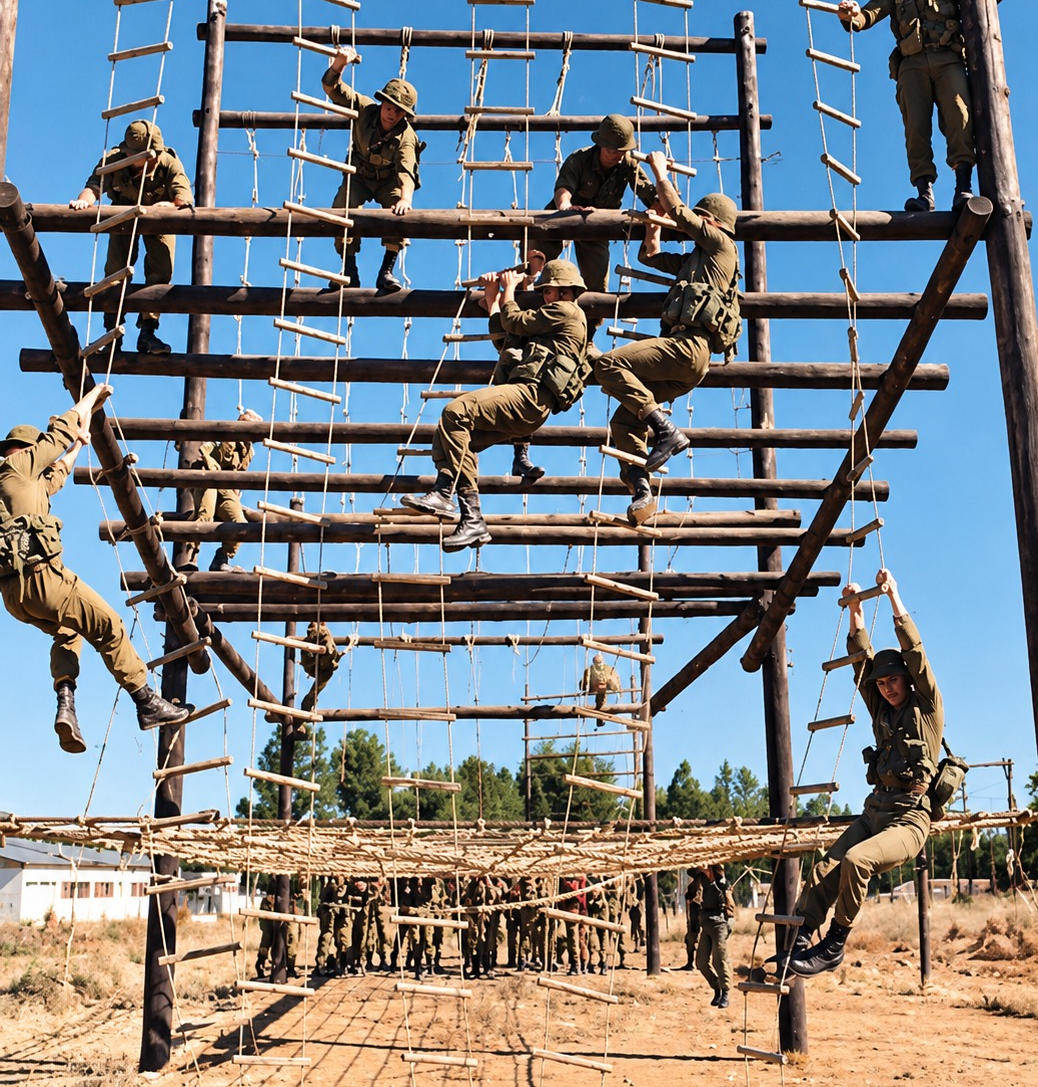
I felt like I had a target on my back. Keeping out of sight once you have been noticed in the Army is impossible.
Since boarding the train, Hilton and I had attracted scrutiny and trouble. Being last to get into the Bedford ensured painful bruises on our ride to Diskobolos. My sunset encounter with Ivan the Red ensured messy gardening duty when everybody else was getting their kits in order. Somebody decided that I needed a rough ride.
Basic training was designed to break you down and rebuild you into the soldier the Army wanted. Your individuality, independence and sense of control over your own life were surrendered to the Army. You were there to obey orders, not question them.
As state property, our bodies and minds belonged to the Army. Our comfort was irrelevant and our preferences immaterial.
Stubborn slaves were few and the system tried to crush us. Spartacus bonded us.
Ignorance is bliss and I loved pissing them off. They retaliated. Being there against my will strengthened my resolve. I was not alone. Others felt the same.
Kimberley’s relentless heat and dust provided a perfect setting for pushing our physical limits. We struggled to survive temperatures above 40 degrees, while the fine dust made breathing difficult.
Training outdoors beneath the African sun in thick brown cotton uniforms in sweltering heat added another dimension to an already demanding routine.
I had never experienced anything quite like Kimberley’s dry heat. Like almost everybody else I could hardly function in it initially. Eventually I became sufficiently acclimatised to train hard in it, but my body never completely adapted. I detested the desert- like conditions.
Humid heat is easier to tolerate. Dry heat demands coping with dehydration, burning dry eyes, sunburn and exertion. I was out of my element.
The Indian Ocean and swimming were my life. I was an aquatic creature coping easily with cold weather and winter swimming. Diskobolos in January was Hell.
We carried our heavy and uncomfortable R1s, which we were ordered to treat with extreme respect. God forbid that your rifle had a spot of dust on it or that you failed to hold it up any longer. Sometimes some Sad Sack dropped a rifle, and Hell broke loose.
Fortunately, we wore the uncomfortable steel helmets, or staaldakke, less often than our ugly little military hats. At some point at the end of an opfok session, we inevitably ended up running, and some of the weaker guys fell behind. We were punished severely for abandoning our buddies. Never abandon your buddies. The fastest man was only as fast as the slowest man.
Thankfully, webbing was not something we wore constantly in ordinary training. Sometimes we escaped daily running around Diskobolos fully equipped like combat soldiers. Opfoks were the colloquial slang used during the apartheid-era of the South African Defence Force (SADF) to define severe, unauthorised, and excessive punishment physical training. The reality was that opfoks were SOPs (standard operational procedures)
Opfoks were an unavoidable routine. They aimed at exhaustion beyond our limits and maximising the fear factor. They wanted us to believe opfoks could be avoided if we obeyed and failed to fail. When the weakest troops started collapsing, we had to support them. Their effectiveness depended on the limits of the platoon’s endurance. Lasting to the last earned some silent respect from the corporal.
Opfoks were extremely serious and some national servicemen occasionally died due to it. These brutal sessions were used by corporals and officers to break the spirit of non-compliant “roofs” like me.
Conscripts died of heat stroke and dehydration, physical abuse, assault and undiagnosed medical conditions. Occasionally we had to run for hours with our over 4kg R1 rifles in heavy stress positions. The SADF rarely admitted abuse in official cover- ups. Actual stats remain secret. There were five deaths in the intake before us.
The army had to break us to achieve their mission of destroying our resistance. Breaking Point.
Their Modus Operandi required no Enigma Code Breaker to decipher. Emotional detachment from Opfoks kept me going. No submission to brainwashing.
Seething icy anger made me almost impossible to break. DB scared everyone though.
Staying in the army longer had to be avoided at all costs. Time spent in DB was added to your National Service. Detention Barracks was worse than Hell. Our hot Bravo Platoon bungalow was cool compared to the over 40 degrees of the small DB jail cells.
After opfoks we would usually be ordered to limp back to the showers and get cleaned up. Maybe I was a bit kinky… There is something sensual about a naked group of athletic guys shoving each other to get under the shower. We were all in pain however, hence the urge to get hot water onto us to soothe our painful muscles and ligaments.
Some of us exaggerated injury. Corporal Ludick was no fool. Under his hard “SS-Untersharfuhrer” exterior he had compassion. He saw through our ploy to avoid further Opfok punishment. He pretended not to know!
Opfoks were Hell, but at least I was better equipped for survival. Martial arts and the psychiatric ward taught me detachment.
Francois was tough, karate trained, super fit and never seemed rattled. He took his time to get showered against the clock. We painfully grinned at each other in the showers.
Maybe he enjoyed voyeurism as much as I did! Besides, our buddies got into excellent shape. Our ugly browns became a lot sexier…
The Army might have been trying to turn us into obedient soldiers, but it had overlooked one important detail.
We were still young men.
Our libidos were alive and well.
I was beginning to understand that there was more to basic training than physical exhaustion. It was psychological. And sensual for some.
The aim was to make you dependent on the group, fearful of punishment and reluctant to stand apart. The group bonded. Essential for surviving war.
And yet, strangely, the Army was also teaching me how to stand apart while respecting the solidarity ethos.
I stopped thinking about the ordeal. I no longer asked myself how much more I could take, because the question itself became too exhausting. Instead, I concentrated on the next instruction, the next task, the next step.
A point came where the physical and psychological pressure became overwhelming.
I began to function almost mechanically, yet psychologically intact.
Detachment worked well. I became almost robotic, simply doing whatever had to be done without thinking too far ahead.
I had experienced something similar during accidents, when detachment activates. Then your mind selectively recalls those moments of physical pain and trauma.
Some memories simply disappear.
Memories can return to some extent. Once you are no longer at breaking point, your mind seems able to process the ordeal.
I remember my training with extraordinary clarity. I’ll never forget the heat, exhaustion and relentless demands.
Being rudely awakened from your deepest sleep at 04h00 is a shock. Corporal Ludick enjoyed shouting sadistically close to the ears of his favourite targets, like me! That, and the bright fluorescent lights pissed me off. A great start to another day!
Punishment push ups followed soon after. I was used to being singled out and took it in my stride. Corporal Ludick was amusingly inventive with his motivational methodology!
Yet there was a peculiar contradiction in all this. The Army might have been trying to grind me down, but I was young and stubborn and refused to surrender.
The Army hated “moffies” (faggots) passionately and could send any suspects to DB. Being gay was against the law with strict jail sentences. Faggots were weaklings. Supposedly. My aggressive attitude and twice-weekly judo training did not fit their Moffie mould. My sexuality remained my selective secret.
Fighting every battle was exhausting. Resisting every instruction, resenting every indignity and challenging authority consumed energy I could not afford to waste indefinitely.
I was determined to win this WAR and adapted to choosing my battles strategically.
My mind refused to accept the Army’s mind control. Resistance became more subtle. Ironically, these were qualities the Army wanted. My anger fuelled resistance.
I could choose to comply without surrender. I conserved energy rather than waste it. Strangely, I began to play their game, but taunting them was in my nature.
Never surrender was the ethos of elite soldiers prepared to die for their mission. The highly sought-after silver-winged maroon beret was the ultimate symbol of South Africa’s best soldiers. They even had their own Google-worthy anthem.
Francois wanted to become a Parabat at the elite 1 Parachute Battalion based at Tempe in Bloemfontein not far from Kimberley. I enjoyed his company and thought I’d tag along. Potential seduction seemed enticing.
Once we conquered Kimberley’s desert conditions, we began doing extra running training. Entrance requirements for 1 Parachute Battalion were severe.
Parabats had to complete an expanded 3.2 km run in full battle dress with R1 assault rifles in under 18 minutes.
It wasn’t some macho competition between Francois and I. We had a purpose.
Apparently, the course had an 80% fail rate. It looked increasingly less appealing.
A silver-winged maroon beret was awarded after 10 months of gruelling training.
1 Parachute Battalion’s training requirements were rated amongst the toughest. A bridge too far for somebody who doesn’t like heat and dust.
We practised the 2.4-kilometre run on flat terrain, lightly dressed, aiming to complete it in under nine minutes. Passing this test could alternatively open the way to further leadership training (JL courses). Depending on your performance, you would be promoted to becoming a corporal or commissioned as an officer. Many failed.
Passing physically was only one part of the process.
Different leadership courses had different requirements, and specialised units had their own selection criteria. Strong physical performance may open a door, but it certainly did not guarantee that you would walk through it.
There were vastly different standards and requirements, and even men who passed the physical tests often failed other elements of selection.
Special Forces selection was different from JL courses, which placed greater emphasis on leadership skills. The training periods were similar in length. Both demanded endurance, fitness, vigilance, independence and teamwork. Special Forces required almost kamikaze-level commitment.
Ironically, the traits that might have improved my chances of acceptance were also a good indication of why I eventually decided against applying.
It wasn’t because I was afraid of heights or endurance. I detested dust and desert conditions.
Something else about parachuting made me distinctly uncomfortable. Somebody else packed my parachute. The Parachute Packing Wing was based at Tempe.
I didn’t trust people that much.
I could contemplate jumping out of an aeroplane without being too worried about the height or the night. Night jumps are the norm.
What concerned me was whether the person who had folded my parachute had done it properly! It seemed risky.
So, I decided against applying to become a Parabat.
As a graduate who passed the physical test, I qualified for the rigorous nine-month JL course. Had I passed this course, I would have been commissioned as a Lieutenant, or, as we called it, a two-pip Lieutenant. Non-graduates became 2nd Lieutenants with one star.
The secrecy and need-to-know system in specialised military units were entirely understandable. Any serious armed force must operate that way. The same principle applies to intelligence organisations such as the CIA, KGB and MI5.
In a specialised unit, you had little or no control over where you went or what you did. Your deployment took you anywhere without telling you why. That bothered me and I still harboured a grudge against the army.
I wanted to remain in control of my own life. Joining an elite military unit contradicted that. So, despite having the fitness and the opportunity, I chose to continue studying.
It was the most important decision I made during my military training. The Army was trying to break me down. Instead, I was learning something about myself.
I could endure far more than I had ever imagined. I could adapt.
I could obey, when necessary, without surrendering my mind. And I could still choose. Ironically, the Army’s attempt to break my spirit was teaching me precisely how strong that spirit was.
Underneath that almost robotic endurance was still the same person who loved the ocean, swimming, freedom, sex, adventure and making his own decisions.
They could exhaust my body. They could control my time. They could cut my hair, dress me in a uniform and tell me where to stand.
They could even put an RSM on my trail. But they couldn’t decide what I wanted my life to become. That decision remained mine.
It was not fear or fantasy that made the decision for me.
It was control.


