

By Mark S. Gold M.D.
- Psilocybin and LSD are advancing through clinical trials. Other psychedelics need more evidence they work.
- A mystical experience among users may feel transformative, but lasting benefits require proof.
- Desperate patients who can’t wait deserve carefully considered access and honest explanations of risks.
- Move quickly with new treatments, but first establish safety and efficacy compared to existing treatments.
Six months before his death at 27, Cindy Crawford’s son Presley Gerber described taking ibogaine for addiction. He hoped to find his way back to himself. His cause of death remains under investigation. His hope deserves respect. People with addiction want their lives back. But an old A.A. saying captures the challenge: “Once you are a pickle, you can never be a cucumber again.” Recovery is possible. Turning back the clock is another matter.
Failed treatments, craving, and suffering can make a new treatment irresistible. Some describe spiritual awakening and turning the clock back with psychedelics. But feeling transformed and sustained recovery are different things.
Listen to patients.
Then test the treatment. Randomized clinical trials (RCTs) help answer what patients deserve to know: Does it work? For whom? For how long? At what risk? Compared with what?
Different Drugs, Different FDA Timetables
Phase 1 studies assess initial safety, tolerability, and dosing. Phase 2 asks whether treatment is promising and warrants larger studies. Phase 3 RCTs examine efficacy, safety, and other outcomes more extensively. With this data, the FDA evaluates and weighs a new treatment’s benefits and risks.
Psychedelic drugs are quite different in their effects. While they are often lumped together, they differ in RCT evidence and progress toward FDA approval. Progress in depression and anxiety does not establish efficacy for SUDs. Each drug needs evidence for each condition. Relieving withdrawal or craving is encouraging. Preventing relapse and overdose over months and years is another test.
Esketamine (Spravato) is now FDA-approved for TRD. The FDA added guardrails with supervised administration and monitoring under a REMS safety program. Spravato is a logical comparison. Psilocybin and LSD deserve the same scientific bar; no psychedelic discount nor a psychedelic penalty.
Progress Towards FDA Approval
COMP360 psilocybin met its primary endpoints in two treatment-resistant depression Phase 3 trials. Its sponsor reports a rolling FDA application and initial review is underway. LSD’s sponsor also reported positive results from its second Phase 3 GAD trial in September. But company announcements aren’t FDA approval.
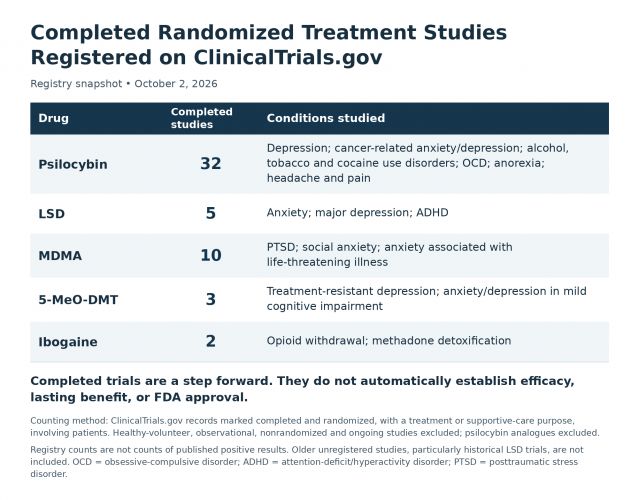
A September 29 JAMA Network Open study of 1,964 U.S. adults adds a warning. Across 13 assessed adverse effects, the higher reported adverse-effect rates were among ibogaine or 5-MeO-DMT users. These findings signal concern, but this was not a controlled drug-safety study. Still, limited evidence of benefit alongside greater reported harm deserves attention. Ibogaine also carries a specific cardiac danger: QT prolongation and potentially fatal arrhythmias. Screening and monitoring matter, but cannot make the drug risk-free. RCTs are needed.
The Blindfold Slips
In a double-blind RCT, neither patients nor outcome assessors should know who received the experimental treatment or placebo. The profound psychedelic “trip” makes that difficult.
Randomization still matters. The drug may genuinely help. But failed masking makes it harder to judge how much benefit comes from pharmacology versus expectations, psychological support, or their interaction. Therapists may behave differently if they know who did/did not take the drug, and symptom ratings may also shift.
Orsini and colleagues reviewed 112 randomized trials and found that only 33 even assessed blinding. Psilocybin, LSD, and ayahuasca studies frequently reported blinding failures exceeding 90 percent among participants and raters. This doesn’t prove ineffectiveness, but it weakens confidence in estimates of the drug’s efficacy
University of Michigan’s Dr. Jacob Aday and colleagues propose that RCTs use active placebos that better reproduce a psychedelic’s mental and physical effects, onset, and duration, while remaining safe and avoiding therapeutic effects of their own. Kevin Yang, M.D., and researchers from UCSF, UC San Diego, and Stanford University call for a more aggressive approach to preserving masking in psychedelic clinical trials. In the September 16 JAMA Psychiatry, they proposed carefully selected control cocktails of psychoactive drugs. They also suggest that participants authorize researchers to withhold selected study-design details, making treatment assignment harder to infer. Their argument: An RCT studying an intense psychedelic experience needs a credible, comparably intense control, with similar supervision and monitoring. But these combinations could themselves cause serious adverse effects, including cardiovascular instability and respiratory depression. Whether these risks are justified—and whether the approach works—remains to be established.
Compared to Existing Treatments
Patients also need direct comparisons with established, effective treatments. Head-to-head RCTs—not percentages from unrelated studies—can tell us which treatment works better and for whom.
Head-to-head RCTs with random assignment—not comparisons of percentages from unrelated studies—are needed to determine which treatment works better, for whom, for how long, and at what risk.
Psychedelic mechanism research is advancing. Joshua Siegel and colleagues showed psilocybin temporarily disrupts usual brain network patterns, with some connectivity changes lasting weeks. A new Nature study of 62 adults found brain activity became more aligned with context—music, meditation, or a movie—and tracked feelings of connection and next-day psychological changes. We still need to establish which changes produce lasting recovery.
A Trial Is Different from Self-Treatment
Compass reports that COMP360 psilocybin met its primary endpoints in two Phase 3 trials for treatment-resistant depression. On September 14, Definium announced the second positive Phase 3 LSD trial in GAD. Other psychedelic trials are moving at their own speed.
A positive RCT does not establish the safety or effectiveness of self-treatment. Researchers study a known drug and dose in selected patients, with supervision, monitoring, and follow-up. Taking mushrooms at home or recreational LSD does not reproduce those conditions.
Selection matters. Trials often exclude people with psychosis or bipolar risk; some also exclude active substance use disorders. Results cannot simply be extended to patients the researchers excluded. Safety assessments must also account for those who worsen or drop out.
The safeguards may disappear. The drug’s risks have not taken a vacation.
Some Patients Cannot Wait
Some patients with OUD remain ill despite evidence-based, FDA-approved treatments. Relapse and continued suffering may deepen depression and hopelessness. The President’s executive order calls for faster psychedelic research and development of access pathways.
VA trials can expand access and help establish whether these treatments work. FDA expanded access may permit investigational treatment for serious or life-threatening conditions when satisfactory alternatives are unavailable.
These routes may allow treatment before FDA approval. Access is not proof that it works. Nor does a pathway guarantee that a patient can get the treatment. Patients deserve compassion and access when justified. They also deserve the truth about what we know, what we do not know, and what could go wrong.
Defining Success
Screen carefully. Put safety first. Continue care. Patients in altered states are vulnerable. No sexual contact. No exploitation. No pushing a therapist’s beliefs.
Registries can help identify uncommon harms and track whether improvements last.
For addiction, a memorable trip is not enough. Neither is easier opioid withdrawal. Can patients rebuild their lives? Use less? Function better? Stay in care? Avoid overdose? Survive? How do outcomes compare with established treatments?
We should move quickly enough to help suffering people. But carefully enough to learn what actually works.
Hope deserves a hearing. Patients deserve the evidence to decide.
References
Simonsson O, Bradley M, Black JC, Rockhill KM, Monte AA, Hendricks PS. Adverse Health Outcomes of Psilocybin, LSD, MDMA, Ibogaine, and 5-MeO-DMT. JAMA Netw Open. 2026;9(9):e2636756. doi:10.1001/jamanetworkopen.2026.36756
Orsini DK, Wong S, Di Luch S, et al. Blinding integrity in psychedelic randomized clinical trials: a systematic review. JAMA Psychiatry. 2026;83(7):755-769. doi:10.1001/jamapsychiatry.2026.0255
Aday JS, Simonsson O, Schindler EAD, D’Souza DC. Addressing blinding in classic psychedelic studies with innovative active placebos. Int J Neuropsychopharmacol. 2025;28(4):pyaf023. doi:10.1093/ijnp/pyaf023
Matvey M, Kelley DP, Bradley ER, Chiong W, O’Donovan A, Woolley J. Modifying informed consent to help address functional unmasking in psychedelic clinical trials. JAMA Psychiatry. 2025;82(3):311-318. doi:10.1001/jamapsychiatry.2024.4312
Yang KH, Heifets BD, Krystal A, Woolley JD. The case for more aggressive masking in psychedelic trials. JAMA Psychiatry. Published online September 16, 2026. doi:10.1001/jamapsychiatry.2026.2858
Compass Pathways. Primary endpoint achieved in the second Phase 3 COMP360 trial. February 17, 2026. https://www.hcplive.com/view/comp360-psilocybin-meets-primary-endpoint-second-phase-3-trial-trd
Compass Pathways. Six-month data from the second Phase 3 COMP360 trial. July 7, 2026. https://www.sec.gov/Archives/edgar/data/1816590/000181659026000047/cmps-20260707.htm
Definium Therapeutics. Positive topline results from the Phase 3 Emerge study of DT120 in major depressive disorder. June 22, 2026. https://ir.definiumtx.com/news-events/press-releases/detail/232/definium-therapeutics-announces-positive-topline-results-from-phase-3-emerge-study-of-dt120-orally-disintegrating-tablet-odt-in-major-depressive-disorder
US Food and Drug Administration. Spravato summary review. 2019.- https://www.accessdata.fda.gov/drugsatfda_docs/nda/2019/211243Orig1s000Approv.pdf
Knuijver T, Schellekens A, Belgers M, Donders R, van Oosteren T, Kramers K, Verkes R. Safety of ibogaine administration in detoxification of opioid-dependent individuals: a descriptive open-label observational study. Addiction. 2022 Jan;117(1):118-128. doi: 10.1111/add.15448. Epub 2021 Aug 9. PMID: 33620733; PMCID: PMC9292417.
Luz M, Mash DC. Reply to Knuijver et al. on the ‘Safety of ibogaine administration in detoxification of opioid-dependent individuals: a descriptive open-label observational study’. Addiction. 2022 Mar;117(3):835-836. doi: 10.1111/add.15694. Epub 2021 Oct 7. PMID: 34542215.
President Donald J. Trump. Accelerating Medical Treatments for Serious Mental Illness. Executive Order 14401. April 18, 2026. https://www.whitehouse.gov/fact-sheets/2026/04/fact-sheet-president-donald-j-trump-is-accelerating-medical-treatments-for-serious-mental-illness/
US Department of Veterans Affairs. VA launches MDMA-assisted mental health therapy trial. May 26, 2026. https://vetsfirst.org/va-launches-new-breakthrough-mdma-clinical-trial-for-veterans-battling-ptsd-and-alcohol-use-disorder/
US Department of Veterans Affairs. VA launches psilocybin trial for veterans with treatment-resistant depression. August 5, 2026. https://news.va.gov/press-room/va-launches-psilocybin-trial-for-veterans-with-treatment-resistant-depression/
Seale-Feldman A, Helland L. Psychedelics have brought mysticism into modern medicine. Researchers are listening. Big Think. September 30, 2026. https://bigthink.com/the-well/psychedelics-have-brought-mysticism-into-modern-medicine-researchers-are-listening/
Associated Press. Presley Gerber, model and son of Cindy Crawford, dies at 27. September 21, 2026. https://apnews.com/article/presley-gerber-dead-cindy-crawford-california-237ebcf4d1cda2811cecd9f8c27b2dab
Siegel JS, Subramanian S, Perry D, Kay BP, Gordon EM, Laumann TO, Reneau TR, Metcalf NV, Chacko RV, Gratton C, Horan C, Krimmel SR, Shimony JS, Schweiger JA, Wong DF, Bender DA, Scheidter KM, Whiting FI, Padawer-Curry JA, Shinohara RT, Chen Y, Moser J, Yacoub E, Nelson SM, Vizioli L, Fair DA, Lenze EJ, Carhart-Harris R, Raison CL, Raichle ME, Snyder AZ, Nicol GE, Dosenbach NUF. Psilocybin desynchronizes the human brain. Nature. 2024 Aug;632(8023):131-138. doi: 10.1038/s41586-024-07624-5. Epub 2024 Jul 17. PMID: 39020167; PMCID: PMC11291293.
Stoliker D, Novelli L, Khajehnejad M, Biabani M, Greaves MD, Barta T, Williams M, Chopra S, Bazin O, Simonsson O, Chambers R, Barrett FS, Deco G, Preller KH, Carhart-Harris RL, Seth AK, Sundram S, Egan GF, Razi A. Psychedelics align brain activity with context. Nature. 2026 Aug;656(8129):936-947. doi: 10.1038/s41586-026-10910-z. Epub 2026 Aug 19. PMID: 42618786; PMCID: PMC13518247.
Katie Zhou, David de Wied, Robin L Carhart-Harris, Hannes Kettner, Prediction of hallucinogen persisting perception disorder and thought disturbance symptoms following psychedelic use, PNAS Nexus, Volume 4, Issue 4, April 2025, pgae560, https://doi.org/10.1093/pnasnexus/pgae560
Sabé M, Sulstarova A, Glangetas A, De Pieri M, Mallet L, Curtis L, Richard-Lepouriel H, Penzenstadler L, Seragnoli F, Thorens G, Zullino D, Preller K, Böge K, Leucht S, Correll CU, Solmi M, Kaiser S, Kirschner M. Reconsidering evidence for psychedelic-induced psychosis: an overview of reviews, a systematic review, and meta-analysis of human studies. Mol Psychiatry. 2025 Mar;30(3):1223-1255. doi: 10.1038/s41380-024-02800-5. Epub 2024 Nov 27. PMID: 39592825; PMCID: PMC11835720.
Patterson Silver Wolf DA, Gold M. Treatment resistant opioid use disorder (TROUD): Definition, rationale, and recommendations. J Neurol Sci. 2020 Apr 15;411:116718. doi: 10.1016/j.jns.2020.116718. Epub 2020 Feb 5. PMID: 32078842.
Source: https://www.psychologytoday.com/za/blog/addiction-outlook/202610/psilocybin-lsd-other-psychedelics-move-to-fda-approval


