
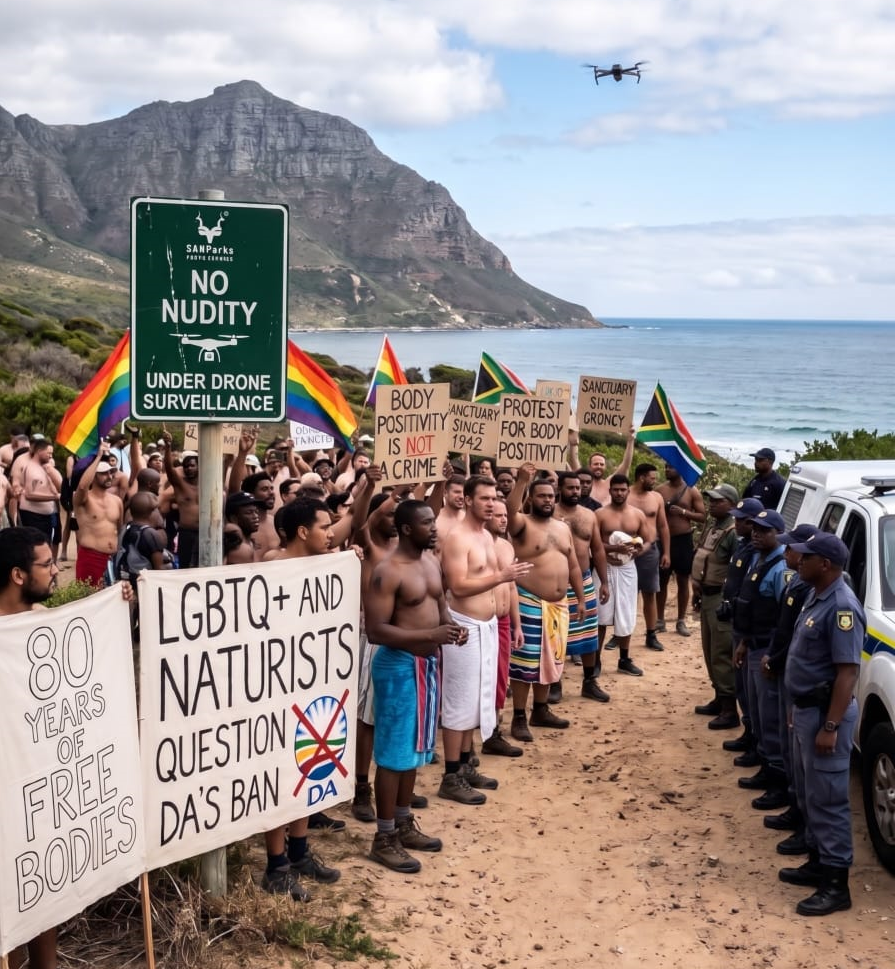
Sandy Bay is once again caught in a battle over prejudice, politics and personal freedom. With WorldPride approaching and municipal elections on the horizon, Cape Town is selling the world a story of diversity, freedom and acceptance. Yet at one of the city’s best-known naturist sanctuaries, that story is being questioned.
Bad news travels faster than tourists.
Naturists, LGBTQ+ people and voters who believe in personal freedom should not surrender their support to any political party that takes it for granted. No party should assume our loyalty while questions about a historic community and its beach remain unanswered.
Cape Town wants international visitors, tourism revenue and the prestige associated with major LGBTQ+ celebrations. Yet Sandy Bay faces prohibition signs, warnings about possible penalties under sexual-offences legislation, and questions about aerial drone surveillance.
Visitors now face uncertainty about a place long associated with clothing-optional freedom. We should not allow a handful of opportunists—or a narrative that has yet to be properly explained—to define the future of an entire community.
I am tired of politicians talking about inclusion when it suits them, then remaining conspicuously quiet when the people behind that inclusion need to be heard.
Sandy Bay is more than another beach. It is part of our naturist heritage and has offered refuge to gay men and others seeking acceptance beyond the judgement of a narrow-minded society.
My message is straightforward: no political party should take our support for granted. And when you vote, do not forget Sandy Bay.
EIGHTY YEARS OF FREEDOM — AND NOW WE ARE SUPPOSED TO ACCEPT THIS?
Sandy Bay’s story did not begin with a tourism website, a municipal sign or a politician’s press release.
For generations, people have made the journey to this secluded stretch of coastline to experience something increasingly difficult to protect: the freedom to be themselves without being judged for their bodies.
Naturists have found acceptance there. Gay men have found community. People who felt uncomfortable or unwelcome in conventional society have found somewhere to breathe.
Consider what that has meant in South Africa, where homosexuality was criminalised and social prejudice restricted how openly gay people could live. In that environment, secluded spaces mattered. They offered opportunities for connection and freedom that mainstream society frequently denied.
Sandy Bay became part of that history.
Its clothing-optional tradition predates the current controversy. When the area became part of Table Mountain National Park in 1998, its established use and reputation were already part of the landscape.
If historical consultations or assurances were given to the community, the records should be made available. If commitments are now being abandoned, the authorities should explain why.
This is not an insignificant change affecting a handful of people who simply want to remove their clothes. It concerns a community, a history and a place that cannot easily be recreated elsewhere.
Once a historic sanctuary is lost, a sign pointing visitors towards another beach cannot restore what has disappeared.
SANDY BAY IS GOOD ENOUGH TO ADVERTISE — BUT IS IT GOOD ENOUGH TO PROTECT?
Sandy Bay is promoted across travel and tourism platforms as a clothing-optional destination associated with naturism and gay-friendly travel. Visitors discover it online, learn about its secluded setting and reputation, and sometimes travel considerable distances to experience precisely what it has historically offered.
Its identity is part of its appeal. Cape Town also benefits from its broader reputation as a destination where different people can find their place.
But what happens when that established identity collides with a new enforcement approach?
Visitors may arrive to find prohibition signs and warnings that leave them uncertain about what is permitted. Regular beachgoers may wonder whether the place they have known for years is being taken away. LGBTQ+ visitors may reasonably question what has happened to the promise of acceptance.
Is Sandy Bay a recognised clothing-optional destination, or is that identity acceptable only when it helps attract visitors?
Tourism advertising does not exempt anyone from the law. The issue is whether the authorities are being clear and consistent about what visitors can expect.
If the rules have changed, explain what has changed and why. Inform the tourism industry and consult the people affected. If Sandy Bay’s naturist character is to be preserved, stop treating its very existence as a problem to be eliminated.
Cape Town cannot credibly promote freedom while making the people associated with that freedom feel unwelcome.
NUDITY IS NOT AUTOMATICALLY SEXUAL. WHY IS THAT SO DIFFICULT TO UNDERSTAND?
One of the most troubling aspects of this controversy is the apparent association between peaceful naturism and sexual criminality.
Let us be clear: being naked is not the same as committing a sexual offence.
People practise naturism for many reasons, including comfort, body acceptance, personal freedom and a desire to experience nature without clothing.
A person lying naked in the sun is not automatically a predator. Adults enjoying a clothing-optional beach are not automatically engaging in sexual misconduct. Nor is a gay man enjoying Sandy Bay evidence of wrongdoing simply because he is gay and naked.
Of course, harassment, sexual assault and genuinely unlawful conduct must be addressed. Nobody is asking for criminal behaviour to be excused.
But why should an entire community feel criminalised because its preferred way of enjoying a beach makes some people uncomfortable?
Warnings invoking sexual-offences legislation can create the impression that nudity itself is equivalent to sexual misconduct. The precise application of the law depends on the circumstances. The authorities should explain clearly what conduct is prohibited and why.
If someone commits an offence, investigate that person. If someone harasses another visitor, address that behaviour. Where there is evidence of criminal conduct, act on it.
Do not lump peaceful naturists together with offenders.
We have spent decades fighting prejudice based on who we are, whom we love and how we choose to live. We should not have to fight those same prejudices all over again simply because we want to enjoy a secluded beach without clothing.
WE HAVE HEARD THIS KIND OF MORALISING BEFORE
South Africa’s history should make us cautious when broad appeals to morality and public decency are used to justify restrictions on marginalised communities.
During apartheid, the state exercised extraordinary control over people’s lives. Gay people experienced criminalisation and persecution, while moral conformity was used to exclude those who did not fit the standards imposed by those in power.
Sandy Bay itself has a history of conflict over nude bathing.
Today’s South Africa is different. Our Constitution protects dignity and equality, and public institutions are expected to act accountably.
Yet arguments about public decency, complaints and protecting children can still shut down debate before it begins.
Of course children deserve protection. Of course people must be protected from sexual harassment. Public spaces also require sensible rules. But these legitimate concerns should not become convenient weapons against an entire community.
Sandy Bay is secluded, and visitors make a deliberate journey along coastal trails to reach it. Its naturist reputation is well established.
If authorities believe the existing arrangements are causing specific problems, they should identify those problems and explain how the restrictions address them.
We did not build a constitutional democracy so that unpopular communities could be silenced by a warning board and the threat of enforcement.
Freedom means little if it exists only for people whose lifestyles everyone already approves of.
WHAT ABOUT THE REAL CRIME AT SANDY BAY?
Sandy Bay is isolated, and visitors have raised concerns about robberies and assaults in the surrounding area. These are serious matters. Everyone using the beach deserves to feel safe.
But if crime is the problem, why is the conversation so dominated by nudity?
Where are the practical discussions about trail security, appropriate patrols, emergency access and effective investigations? Why should peaceful beachgoers become the focus of restrictive measures when protecting people from actual harm should be a priority?
Regular beach users can provide an informal presence. They notice things, help one another and report suspicious activity. Whether restricting their presence would affect overall safety requires proper assessment. Excluding people who care about Sandy Bay is not automatically a safety strategy.
I want the beach to be safe for naturists, gay visitors, walkers and everyone else using the coastline.
Protect the beachgoers. Pursue the criminals. Do not confuse the two.
WHOSE BEACH IS IT, ANYWAY?
Sandy Bay lies near affluent coastal communities, including Llandudno and Hout Bay. Residents have every right to raise concerns about safety, conservation, litter and visitor behaviour.
But they are not the only people with an interest in the beach.
What about naturists who have travelled there for decades? What about gay men who regard it as a historic refuge? What about South Africans who cannot afford exclusive coastal properties but have an equally legitimate interest in public spaces?
Their voices matter too.
Reports that local ratepayer organisations or Community Improvement District structures supported or funded the new signage deserve public scrutiny. We need to establish who paid for the signs, who authorised their installation, which authorities made the relevant decisions and what consultation took place.
These questions should be answered with records, not rumours.
The principle is simple: public space should not be shaped solely by the preferences of the most influential people living nearby. A public beach is not an extension of a private estate.
If an established use of public space is to be restricted, the decision should be properly justified, and the people affected should have a meaningful opportunity to be heard.
Nobody should be able to turn public land into their preferred private environment simply because other beach users make them uncomfortable.
WHO DECIDED THIS — AND WHY WERE WE NOT HEARD?
This is a basic question of fairness.
If authorities want to change the way Sandy Bay has been used for generations, why should the people who use and value it not have a meaningful say?
Were regular beachgoers consulted? Were naturist organisations approached? Were LGBTQ+ representatives invited to participate? Were alternatives discussed? Was the community given a clear explanation of the decision?
South Africa has laws governing fair administrative action, and public institutions are expected to act accountably. Whether the specific measures at Sandy Bay comply with those requirements depends on the actual decisions and applicable rules.
But ordinary people should not need a law degree to ask why a longstanding public practice is suddenly being restricted.
We should not have to discover a major change through a sign threatening penalties, guess which authority is responsible or accept that a decision is fair simply because a public institution has made it.
If the authorities have good reasons, explain them. If the community has been misunderstood, listen. If there are genuine problems, work with the people who know the beach rather than treating them as enemies.
We are not asking to be above the law. We are asking not to be pushed aside without a fair hearing.
WORLDPRIDE: RAINBOW FLAGS ARE EASY. STANDING UP FOR PEOPLE IS HARDER.
WorldPride will provide an opportunity to celebrate LGBTQ+ lives, achievements and freedoms. That celebration matters. Visibility matters. Tourism matters.
But none of it should become an excuse to ignore what happens outside the festival programme.
LGBTQ+ people are not simply an audience for an event. We are residents, workers, business owners, voters and members of communities with real concerns about how our city is governed.
Naturists are not merely a marketing category. We are people who value a particular way of experiencing nature and deserve to be treated fairly.
The real test of inclusion comes when a minority community’s traditions conflict with the preferences of a more powerful group. What happens when a longstanding sanctuary becomes politically inconvenient? What happens when a community asks its elected representatives for support and receives silence instead?
Anyone can put up a rainbow flag or write an inclusive tourism slogan. The real test is whether that commitment to dignity and acceptance extends to people whose lifestyles may not be universally understood or accepted.
If inclusion disappears when it becomes inconvenient, it was never much more than a slogan.
DA SUPPORTERS: IT IS TIME TO ASK SOME UNCOMFORTABLE QUESTIONS
I am not interested in telling every naturist or LGBTQ+ voter which party they must support. Our communities are diverse, and people have different priorities.
But I challenge the assumption that the DA can count on our votes regardless of what happens at Sandy Bay.
The party has cultivated a reputation for liberal values and constitutional governance. Those who support it on that basis are entitled to ask questions when decisions made or supported by public institutions appear inconsistent with the principles of inclusion the party promotes.
Responsibility must also be established accurately. SANParks is a national institution, while the City of Cape Town and the Western Cape government have different powers and responsibilities. Each institution’s precise role in the Sandy Bay restrictions must be clarified.
We should demand answers from the relevant officials, councillors and election candidates rather than allow anyone to hide behind institutional confusion.
Ask them:
- Do you support the current restrictions at Sandy Bay? Why?
- Will you explain the legal basis for the prohibition signs?
- Will you support meaningful engagement with naturists and LGBTQ+ beach users?
- Will you advocate practical action against crime without unnecessarily excluding peaceful visitors?
- Will you defend Sandy Bay’s historical significance and clothing-optional tradition?
- If you disagree with the current approach, what are you prepared to do about it?
Do not accept vague statements about inclusivity as substitutes for concrete answers. Ask what candidates will do, when they will do it and whether they will put their commitments on record.
No political party owns our votes, and no political party is entitled to our silence.
If the DA believes it deserves the support of naturist and LGBTQ+ voters, it should explain its position on Sandy Bay. Other parties seeking that support should explain what they would do differently.
Ultimately, voters must decide whether politicians’ actions deserve their support.
WHAT I WANT TO SEE HAPPEN
I do not want endless arguments while Sandy Bay’s future hangs in the balance. I want answers, transparency and a fair, practical solution developed through engagement with the community.
Specifically, I want:
- SANParks and the responsible authorities to explain the restrictions and publish the relevant rules and decisions.
- Clarity about whether drones are being used, who operates them and how privacy is protected.
- The funding and authorisation of the signage to be examined openly.
- Naturist organisations, LGBTQ+ representatives and regular beach users to have a meaningful opportunity to participate in discussions about the beach’s future.
- Effective action against crime on the access trails.
- Public representatives to take the issue seriously, rather than dismiss it because it concerns a secluded beach and a community that is not always understood.
We can have sensible rules, protect the environment, address genuine safety concerns and deal firmly with harassment and criminal behaviour without casually discarding Sandy Bay’s history or dismissing the people who have made it what it is.
That is what responsible governance should look like.
MUNICIPAL ELECTIONS ARE COMING. DO NOT FORGET SANDY BAY.
Sandy Bay is about more than nudity. It is about dignity, freedom and a historic space where people have found acceptance in a society that has not always offered it.
It is about whether a city that celebrates diversity internationally is willing to respect that diversity in its own backyard. It is also about whether political representatives understand that our support must be earned, not assumed.
I want Sandy Bay protected as a place where peaceful naturism can continue, subject to fair, lawful and proportionate rules. I want its history acknowledged, its community heard and genuine safety concerns addressed.
If you are a naturist, remember Sandy Bay. If you are LGBTQ+, remember the history of the spaces that allowed people like us to find one another when society offered little acceptance. If you believe in personal freedom, dignity and fair treatment, pay attention to what is happening here.
And if you support the DA, ask your representatives what they are doing about it. The same applies to every other party. Party loyalty should never prevent us from asking difficult questions.
Do not let politicians celebrate our community during Pride while ignoring our concerns at Sandy Bay. Do not let them use our diversity to market the city while treating our historic sanctuary as expendable. And do not assume that a party speaking the language of freedom will always defend it when the pressure is on.
Ask questions. Demand answers. Make your voice heard.
When you stand at the ballot box, remember the signs at Sandy Bay, the people who have fought to preserve its character and the questions that still need answers.
OUR BODIES ARE NOT THE PROBLEM. OUR HISTORY IS NOT DISPOSABLE. AND OUR VOTES ARE NOT GUARANTEED.
WorldPride is coming. Municipal elections are approaching. Make Sandy Bay part of the conversation, make our voices count and, whatever your political allegiance, do not forget Sandy Bay when you vote.
The beach may be secluded. Our voices should not be.


