
By Henry Giardina
Protestant moralism meant that films after 1934 couldn’t show sex, gender deviance, or any kind of moral ambiguity. Queer characters who did show up onscreen had to be punished, and even a long kiss had to end by fading to black before things got too steamy.
The code did its best to erase queer lives from the screen, which is why so much of the queerness of classic films—from All About Eve to Laura to Tea and Sympathy—only survives through subtext.
But before 1934, it was a completely different story. Illicit sex, effeminate men, and masculine women were everywhere in the days before the code, and in the silent era, it wasn’t uncommon for queerness to show up even in the most mainstream Hollywood films.
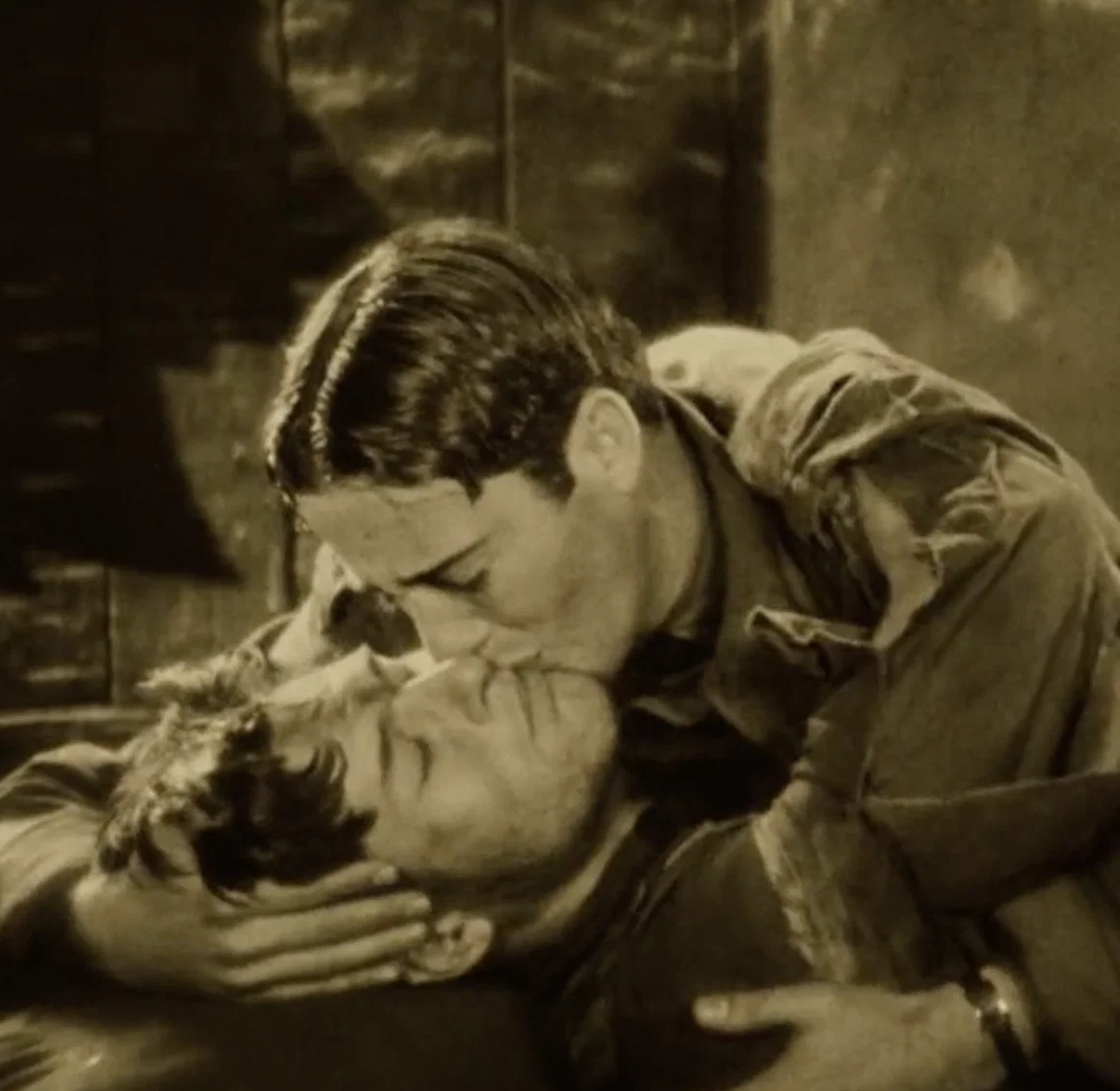
Consider 1927’s Wings—not only was it the first-ever recipient of the Academy Award for Best Picture, it’s also the film that gives us the first onscreen gay kiss.
The specifics of the kiss aren’t as gay as we’d like, of course.
In 1927, you could show affection between men onscreen, as long as it existed in the context of a super-patriotic war film, which is exactly what Wings was. The tale of two air force flyers who come of age in World War I, Wings centers around the friendship of Jack Powell (Charles “Buddy” Rogers) and David Armstrong (Richard Arlen.)
The two grow up together, date the same woman (the original It Girl Clara Bow), and after a harrowing battle scene, David dies in Jack’s arms, giving us the first gay screen kiss. It’s meant to be a kiss of friendship—because who doesn’t make out with their friends?—but because it’s a film about male friendship, it’s hard not to read the final moments as a sweet, if accidental, blessing upon the intimacy these men have shared through their lives.
But there’s even more gayness in Wings than the final kiss. One of the film’s most famous shots involves some crazy dolly action, a subversive French cafe, and a lesbian couple caught in a moment of intimacy.
It’s a blink-and-you’ll-miss-it moment, but it’s there just the same. As the boys get some time off from dogfighting, they dip into a realistic Parisian cafe where queerness is right there in the open.

The lesbian couple in question are both wearing masculine apparel and very stylish headwear. They look like they’d be right at home at the famous 1920s sapphic hangout Le Monocle in Paris or 129 MacDougal St. in New York.
There’s so much to appreciate about this shot—the queerness, the fluidity of the camera movement, the sense of a sprawling wartime atmosphere in which anything goes, even relationships which, at the time, were seen as taboo. Director William Wellman didn’t realize he’d be creating gay history with the film, but he put a lot of thought into creating the dolly shot that still dazzles audiences nearly 100 years later.
“I did the first big boom shot in Wings, when the camera moved across the tables in the big French café set,” Wellman told historian Kevin Brownlow in his silent film oral history The Parade’s Gone By.
“Then everybody got on a boom, and me and [director John Ford] got right off. We both agreed we’d never use the thing again. There’s too much movement. It makes some people dizzy…and they become more conscious of the camera movement than they are of what the hell they’re filming.”
Dizzying though it was, the shot paid off. In the silent era, when the camera was a gigantic apparatus not easily given to smooth, sweeping movement, special tracks had to be built to give us some of the bravura shots we remember best today.
Wellman’s experiment with tracking shots—along with having to film the bulk of Wings literally in the sky—cured him of the desire to do complex moving shots. “I realized that the best thing was to make the picture the simplest way you could.”
But it’s the movement that makes this scene so wonderful. Despite the fact that the cafe is a Hollywood set, it really feels like a glimpse into what life must have been like during 1918, when queerness wasn’t yet widely criminalized or scapegoated the way it would come to be later on in the 1920s.
Before Prohibition and a series of well-publicized Hollywood scandals came along in the early 20s to shock everyone back into an era of moral puritanism, there was an aspect of queer life that was out in the open, both onscreen and in city life. And then, everything changed—as it so often does.
“The climate in New York City in the summer and fall of 1923 was informed by open hostility as expressed by the Society for the Suppression of Vice,” writes biographer Gary Marmorstein in Ship Without a Sail: The Life of Lorenz Hart. “Under its second leader, John Sumner, [the society] launched a campaign in cooperation with the New York Police Dept. to root out homosexuality in bathhouses, on the piers and in the shadowy streets beneath the elevated where men congregated for sex.”
“The north end of the Ramble in Central Park was already known as ‘The Fruited Plain.’ Drag balls were advertised as being for ‘Tom Boys and Girls’ so that the publications that ran the ads could disavow their meaning if readers complained.”
Fortunately, there was still a ten-year period when, if you couldn’t enter the bathhouses without fear of a raid, you could at least see yourself onscreen. But with the coming of the code in the mid-30s, even the little on-screen representation we had dried up, leaving queer viewers in the dark.
Perhaps that’s why these queer moments in Wings remain alive in the culture, frequently shared on IG, Reddit, and TikTok. When queerness was shunned and forced into obscurity, small glimpses of queer life mattered to viewers and remained in the public memory. It doesn’t feel like an accident that the most memorable parts of Wings don’t have to do with its bravura fighting shots or in-air heroics. It’s remembered for the bravery of its depictions of same-sex love, and that will always be its strongest legacy.
Source: https://www.queerty.com/this-silent-film-made-gay-history-heres-how-they-got-the-iconic-shot-that-changed-everything-20250714/?utm_source=queerty&utm_medium=directlink&utm_campaign=external&utm_content=898747


