
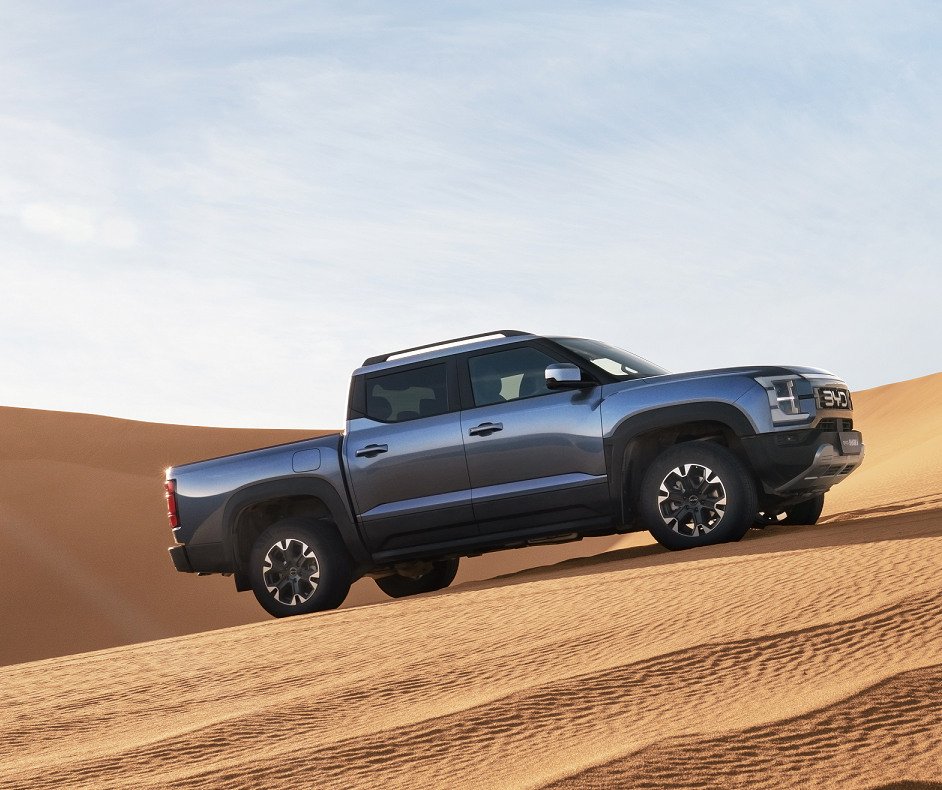
This bold plug-in hybrid bakkie marks new territory amongst competitors.
The BYD Shark 6 is a 4-seater double-cab plug-in hybrid bakkie that ruffles many feathers in a market dominated by bakkies like Toyota Hilux, Ford Ranger, and Isuzu D-Max. Being a hybrid it combines electrified efficiency with hair raising performance and utility, which is not what we used to expect from a double-cab.
The little 1.5-litre turbocharged petrol engine paired with two electric motors surprised me with a combined output of 321kW and 650Nm of torque. Sprinting to 100km/h in just 5.7 seconds, rivals many performance SUVs and surpasses most diesel competitors. The 29.6kWh BYD Blade-LFP battery, gives an electric-only range of about 85-100km, suitable for most urban and short-range commuting needs. A tank of fuel extends range to about 800-840km, which is good for long-distance travel. Charging options include both standard AC and fast DC chargers, offering flexibility for urban and highway use.
Ride and handling are strengths of the Shark, but it feels speedbumps a little more than some competitors. Many pickups rely on leaf-spring rear suspensions, versus the independent front and rear double-wishbone suspension of the Shark allowing superb handling. Ground clearance between 210-230mm accommodates moderate off-road terrain. Terrain modes such as Mud, Sand, and Snow optimise traction and throttle response accordingly. Unexpected highway stability, responsive steering, and minimal body roll, are rare traits for hybrid utility vehicles.
The plush interior has an unusual 15.6-inch rotating central touchscreen on the dash, complemented by a 10.25-inch digital instrument cluster and optional head-up display. Connectivity includes Apple CarPlay and Android Auto, while BYD integrates a suite of driver-assistance technologies such as adaptive cruise control, lane-keeping assist, automatic emergency braking, blind-spot monitoring, and 360-degree cameras. Supportive seats are comfortable for all aboard. A quiet cabin during electric-only operation hushes conversations. Clever storage has multiple compartments and a practical double-cab bed capable of handling daily work or recreational loads.
Efficiency is one of Shark’s standout features. When leveraging the hybrid system optimally, fuel consumption can drop to as low as 2L/100km, a remarkable improvement over diesel counterparts. Even when operating solely on petrol, combined fuel consumption averages between 7.5-9.6L/100km. Payload capacity is approximately 835kg, and towing capacity is up to 2 500kg braked, sufficient for most light- to medium-duty hauling tasks. Vehicle-to-Load (V2L) functionality allows owners to power tools, camping equipment, or appliances directly from the bakkie, adding versatility that few competitors offer.
Performance-wise in the South African market, I am unaware of any brute power rivals, but Toyota’s Hilux 2.8 GD-6 is renowned for reliability, with slightly higher towing capacity and traditional diesel utility. Ford Ranger Raptor is a little slower and thirstier, but superior off-road.
Isuzu D-Max and GWM Cannon are tough and affordable, but lack hybrid efficiency and electric-only range.
The BYD Shark’s combination of power, extremely fast acceleration, electric-only commuting capability, advanced tech, and hybrid efficiency places it uniquely in the market. Being a super-fast workhorse requires getting used to.
It is pricier than some rivals, but operational costs are lower due to fewer moving parts and no regular oil changes. Strong battery warranties and the hybrid drivetrain’s durability should ensure resale value. It is impressive in urban environments where daily electric driving is feasible.
It is massive but remarkably agile for its size, with instant torque from the electric motors making stop-and-go traffic effortless. Highway cruising is stable, quiet with minimal wind or road noise intrusion. Off-road trials demonstrate its capability on gravel, mud, and light sand. While not a hardcore 4×4 for extreme conditions, it meets the practical off-road needs of most owners.
South Africa’s EV market is poised for significant growth, rising from an estimated 2-4% of new vehicle sales in 2026 to potentially 10-15% by 2030, spurred by infrastructure development, model availability, and fleet electrification. Hybrid efficiency, strong performance, and premium tech capture early adopters, urban professionals, and environmentally conscious fleet operators.
Boegoebaai’s Hydrogen and Mineral Hub potential is something that almost no one knows about but the Boegoebaai port in the Northern Cape will soon be a strategic green hydrogen and mineral export hub. This initiative, coupled with South Africa’s abundant critical minerals such as manganese and platinum-group metals, could attract automotive manufacturers seeking integrated supply chains. Proximity to renewable energy, rare minerals, and deepwater export facilities to especially Africa and Europe make Boegoebaai an ideal location for battery component production, hybrid bakkie assembly, and hydrogen-powered logistics. The fact that one of the investors is Rotterdam deep water port illustrates the commercial, industrial and supply chain value. It will be interesting to see who the first manufacturers would be in this oil, gas and mineral rich area only 30km from the Namibian border.
BYD’s battery production credentials make it a player to watch, besides the game-changing Shark, which may just align with our local production potential matched to emerging renewable energy and mineral infrastructure.


