
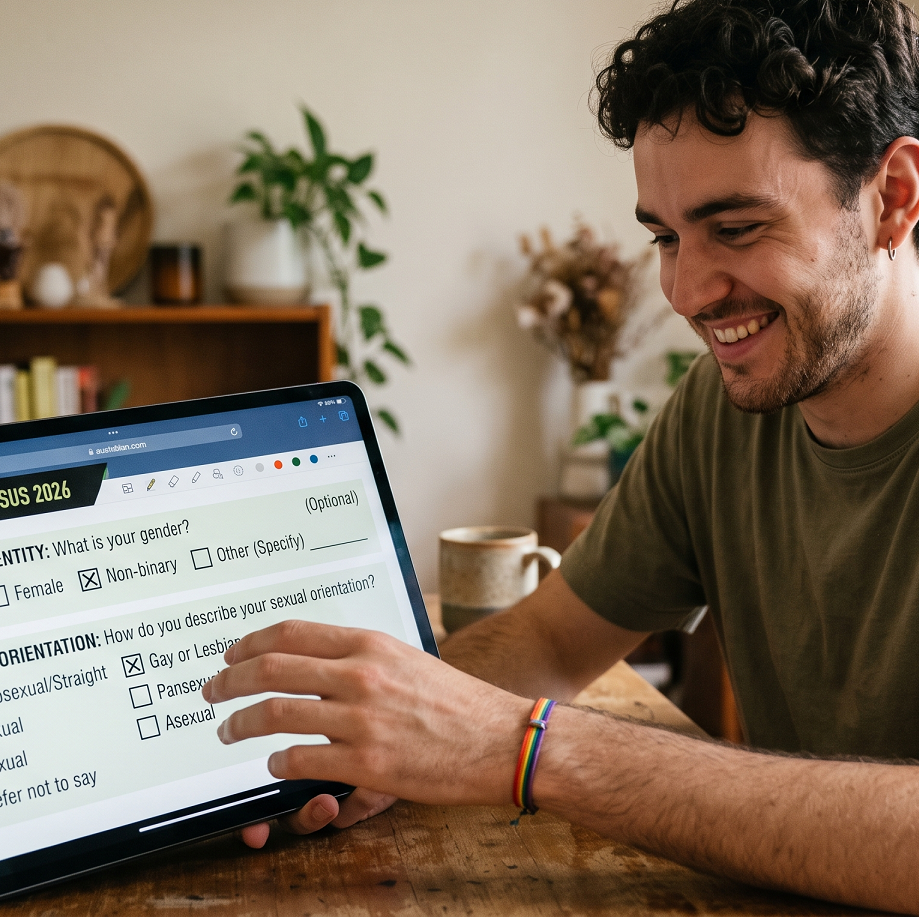
Australia asked about gender and sexual orientation for the first time on census night, 11 August. Both questions went to people aged 16 and over. Both carry a “prefer not to answer” option. Australia was not the first country to do this, and it is not the most thorough.
What the Census Actually Asked
The Australian Bureau of Statistics used three questions. “What was the person’s sex recorded at birth?” has a long history, in some form, in every census since 1911. The two new ones are “What is the person’s gender?” and “How does the person describe their sexual orientation?” Results come out in three phases from June 2027.
The form never uses the words “cis”, “trans” or “gender diverse”. The ABS derives those figures by comparing the sex at birth answer against the gender answer.
Two gaps stand out. The first is age. The gender question stops at 16, so parents of trans and gender diverse children have no way to report them. The ABS actually tested the sexual orientation question at 15 and over, in line with its own 2020 statistical standard, but the government legislated the topic at 16 and over.
The second is intersex. There is no question on variations of sex characteristics, and the reason is more specific than it has generally been reported. The ABS did build and test one. In September 2024 it published the findings: understanding of the question, comfort answering it, and grasp of why it was being asked were all lower than for the sex, gender and sexual orientation questions. Participants confused it with those other questions. The problems were sharpest among people from different cultural and linguistic backgrounds. The ABS also said its own LGBTIQ+ Expert Advisory Committee advised that simplifying the wording any further would increase misreporting. So it was cut.
Anna Brown, chief executive of Equality Australia, told SBS News the organisation would keep pushing for intersex Australians to be counted. “We know that if we aren’t counted, we remain invisible in the data that shapes decisions about our lives,” she said. Did you answer both questions, or leave them blank?
It Nearly Did Not Happen
In August 2024 the government ended the ABS topic review without the questions, with reporting at the time pointing to nerves about a divisive public debate. A Labor backbench revolt followed. Inside about a week, Treasurer Jim Chalmers confirmed both questions would run after all.
New Zealand Did It Better Three Years Ago
This is the comparison that stings. New Zealand’s 2023 census asked everyone their gender, with no age floor, and asked people aged 15 and over about sexual identity and about variations of sex characteristics.
The results: 172,383 adults, 4.9 per cent, counted as LGBTIQ+. Some 26,097 people, 0.7 per cent, were transgender. And 15,039 people, 0.4 per cent, said they knew they were born with a variation of sex characteristics. That last one is the question the ABS decided could not be asked reliably.
Canada Asked First, Then Narrowed It
Canada beat Australia by three months, putting sexual orientation on its May 2026 census. The catch is reach. The question sits only on the long form, which goes to roughly a quarter of households, and only to people aged 15 and over. The categories are heterosexual, lesbian or gay, bisexual or pansexual, plus a write-in box. Canada added a gender question separate from sex at birth back in 2021, three cycles ahead of Australia. Its working estimate going in, drawn from health survey data, was 4.4 per cent LGB+.
America Is Going the Other Way
The United States decennial census has never asked either question. The 2020 count let households record a same-sex spouse or partner, and that is the extent of it. Work to change that has stopped. Executive Order 14168, signed on 20 January 2025, directs agencies to recognise two sexes and states that agency forms requiring sex “shall list male or female, and shall not request gender identity”. The Census Bureau halted its research into adding gender identity to the American Community Survey. A Williams Institute analysis published in February 2026 counted roughly 360 affected federal data collections, with hundreds of gender identity measures and dozens of sexual orientation measures stripped out. More than 80 per cent of those changes went through without public consultation.
Britain Asked Early and Got Burned
England, Wales and Northern Ireland all asked about sexual orientation in their 2021 censuses. Scotland followed in 2022. Every one of those questions was voluntary and limited to people aged 16 and over. LGB+ came in at 3.2 per cent across England and Wales, 4.0 per cent in Scotland and 2.1 per cent in Northern Ireland.
Gender identity is where it came unstuck. England and Wales asked; Northern Ireland did not. The England and Wales result, 262,000 people or 0.5 per cent, no longer stands as an accredited official statistic. In September 2024 the Office for National Statistics asked the regulator to downgrade it, conceding the question had not worked as intended and that some people had found it confusing. Scotland ran a separate question on trans status or history and recorded 19,990 people, 0.44 per cent. Ireland goes next on 9 May 2027, with both topics confirmed.
Asia Counts Sex, Not Sexuality
Across Asia the movement has been on gender categories, and it has been slow. Nepal offered a third gender option back in 2011, but LGBTIQ+ organisations rejected the resulting figure as misleadingly low and asked for it to be struck from the record. For 2021 the wording was changed to “other” after consultation with those same groups, and enumerators were trained for it, though Nepal’s own statistics bureau said publicly that the count would still come in under the real number. India has offered an “other” box since 2011, when 487,803 people used it, though that box is not a question about being trans. Japan and South Korea ask nothing about sexual orientation in their national counts, which is why researchers there work from independent surveys instead.
Why Any of This Matters
Money, mostly. Census data decides where health services, aged care and housing support get funded and built. Nicky Bath, chief executive of LGBTIQ+ Health Australia, told SBS News about older people who contacted her before the 2021 count, upset that they would not live long enough to be counted in 2026. “The decision has been a long time coming,” she said. Some of them were right.
Source: https://www.dnamagazine.com.au/census-sexuality-questions-australia-world/


