
In December 1985, I spent my postgraduate vacation with my gorgeous, warm-hearted boyfriend, Dolf Claassens, on his father’s renowned farms in Bothaville, in the Orange Free State, South Africa.
Oom Piet Claassens was famous for breeding gigantic South African champion Brahman stud bulls and award-winning dairy cattle. For decades, the farm had produced prize-winning livestock, and the walls of the homestead were covered with awards and photographs celebrating those achievements. His study and pristine 1960s-style lounge were forbidden areas.
Before our visit, Dolf warned me that his father was intensely homophobic and that this had caused an irreparable rift between them after the premature death of his mother. Dolf was one of the heirs to the family legacy, but he had no interest in it. He was a passionate animal lover who cared far too much about the fate of the farm animals he loved like pets.
He later abandoned the farms, left Bothaville and distanced himself from the conservative Dutch Reformed community in which he had been raised. He never lost his faith as a devout Christian, however, and asked his younger sister, Annelise, to have him buried in Bothaville with his favourite copy of the Bible.
He died at the young age of thirty-three and never came to terms with his mother’s early death. They had been soulmates, and he mourned and missed her terribly.
At the centre of that staunch community stood Dominee Pieter Cilliers, whose sermons frequently focused on sin and damnation. His fiery sermons made a deep impression on the congregation, reinforcing conservativism that left little room for people like us.
Pieter Cilliers was extremely brave when he eventually came out of the closet himself and became a gay icon with his successful book ‘n Kas is vir klere, which translates as A Closet Is for Clothing. As a public personality he made a formidable contribution to exposing homophobia at every level, including the self-hating homophobia of gay people who feared exposure.
Naturally, as gay activists, our paths crossed at times, and we were aware of the positive impact we were both making. I don’t recall ever discussing my intimate Bothaville history with Pieter.
As a young graduate from the University of Port Elizabeth, I was naïve enough to believe that charm, good manners and a willingness to engage with people could overcome almost any prejudice. I underestimated the intensity of some negative beliefs.
Meeting such a stern, conservative man, who was absolutely direct and unapologetic about his belief that we needed to straighten ourselves out, rattled me to my core. His handshake was strong, and his soul-piercing eyes were frightening. I was a laid-back, naïve, coming-of-age gay boy who grew up in a relaxed beach town like Port Elizabeth.
I had spent my youth swimming among shoals of dolphins that sometimes seemed to accept me as part of their world as I paddled almost daily out to sea on a Kings Beach surf lifesaving rescue paddle ski. Supportive friends had shielded me from much of the harshness of an intolerant world and the impact it could have on gay youngsters.
Oom Piet was in his sixties and highly accomplished. I was twenty-two, with barely a penny to my name, but my heart was filled with joy, and I dreamed of love. Perhaps those opposite qualities—our age difference, but also a shared belief in hope and simply doing one’s best—would eventually help remove some of the barriers between us.
When I arrived at the Claassens homestead, I found myself surrounded by reminders of a lifetime devoted to cattle breeding. Apparently, the forbidden study contained the most prestigious trophies, certificates, championship rosettes and photographs of prize-winning animals that had earned national recognition.
This was far more than just another Orange Free State farm beside the Vaal River, the lifeblood of Johannesburg and the surrounding region. The Claassens dynasty of champion livestock had been built over generations through hard work and expertise, including sophisticated veterinary practices such as artificial insemination using the best bloodlines available from world champions.
The Claassens were a proud but deeply religious and humble family who took little personal credit for their success, believing it was God-given.
What happened next taught me a lesson about champion Brahman bulls that I would never forget.
I struggled to wake at 04h00 the next morning. Oom Piet had warned me upon my arrival that this was not going to be a holiday. I was expected to wake early and work as hard as everyone else, long before a generous breakfast.
One of my first duties was to assist with dipping gigantic Brahman bulls weighing over 1,100 kilograms.
Because it was so early, I simply threw on whatever I could find. Unfortunately, that happened to be an old, washed-out slogan T-shirt bearing the barely visible words:
“Sex instructor, first lesson free.”
Talk about making a good impression.
The same T-shirt, when it was new and clearly legible, had once got me thrown out of one of my first university classes by the strict Dr Scharf, who looked like a member of the Gestapo with his blond brush cut. A cute surfer, Sean Mostert, a Rob Lowe lookalike sitting next to me, thought the drama was hilarious.
We became friends over the years, and he had a gay brother he wanted to introduce me to. Clearly, Sean saw right through me. I still wonder what might have happened if he had moved in the right circles in Hollywood.
The Brahman bulls were standing quietly but nervously in a separate enclosure from the cattle dip when I first noticed the grumpy one. Even from a distance, his size was intimidating.
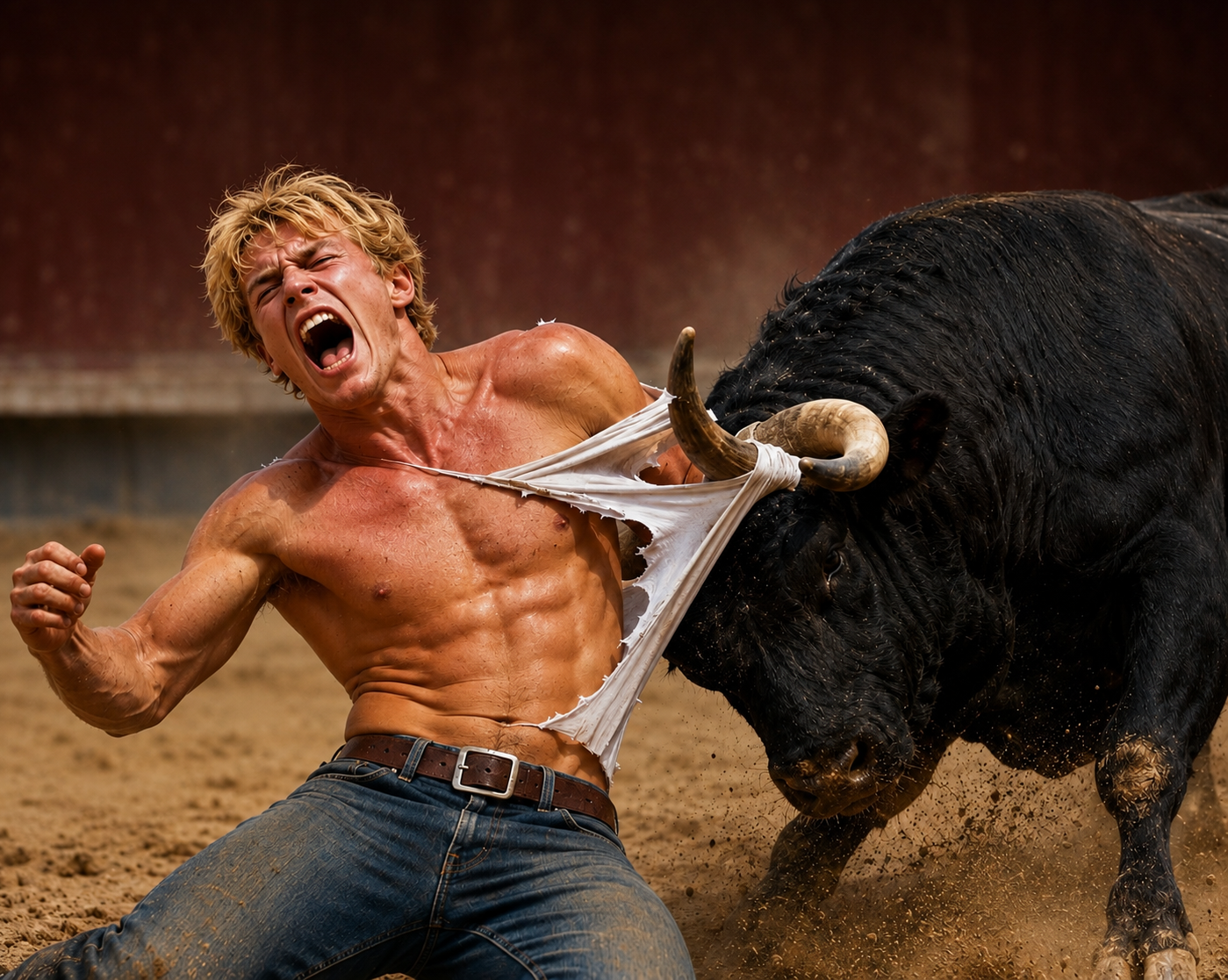
As a beach-loving city boy with little experience of champion stud cattle, I had no idea that within minutes this powerful animal would break through the enclosure and swing his massive horns towards my ribcage.
Half asleep, I suddenly sensed danger. The herd was tense and nervous, displaying all the signals animals give when they feel threatened or uncomfortable. I may have been more at home in the ocean than on land, but my frequent encounters with dolphins and sharks had taught me to recognise distress signals. My rare encounters with killer whales were another matter entirely. Those were terrifying, and I doubted whether oceanic apex predators were intimidated by anything.
Brahman bulls are highly intelligent and trainable, but they remember past experiences, which can make them unpredictable and dangerous simply because of their enormous size. They are sensitive and intuitive animals and respond instinctively rather than
being deliberately aggressive.
This bull suddenly charged through the safety fences as though they didn’t exist and swung his massive head at my chest. His horns shredded my favourite old T-shirt, missing my heart by millimetres.
Leaping backwards probably saved my life.
Unfortunately, I landed helplessly in a urine-filled cow-dung pond with barely my head above the surface.
It was not exactly the dignified introduction to farm life I visualised.
The enormous bull snorted triumphantly and strolled away.
Later, I learned that Brahman bulls were incredibly powerful and among the toughest cattle to handle when angry. They hate being dipped or forced to do anything they did not want to do. Even experienced farmhands are scared to dip them, and my cowboy skills were zero.
This massive bull could easily have killed me, but I think he had made his point and decided there was no need to pursue his attack. Maybe he simply took pity on me, looking so pathetic in the cow-dung pond.
For several seconds, nobody moved. We were all watching the bull, terrified that he might change his mind. After what he had just demonstrated, I knew that if he turned around and came back for me, I was dead meat.
Then Oom Piet and I started laughing.
Within seconds, we were laughing so uncontrollably that tears streamed down our cheeks. Oom Piet, who spent millions on air-conditioned tractors and livestock, removed his glasses—which were held together with Sellotape—to wipe away the tears.
Suddenly, I realised that this ridiculous encounter might have removed some of the enormous barriers between our completely opposite worlds.
Dolf was furious.
He shouted that we were both completely insane. This was not funny. I could have been killed.
He stormed away, leaving the two laughing nutcases behind.
From that moment, Oom Piet and I crossed an unexpected Rubicon and bonded in a strange, inexplicable way.
He was a highly educated man, and we would discuss everything from Descartes to the economy late into the night. Our first serious conversation was about artificial insemination, using semen he imported from countries such as the USA.
He thoroughly enjoyed teaching me about his passion: breeding champion livestock.
This unfamiliar world fascinated me. His son Japie had completed postgraduate agricultural studies and was familiar with the latest scientific techniques used for agricultural artificial insemination.
I looked forward to learning more from this wise old man and his son. It was completely different from what I had learned at university, where I majored in Psychology, Sociology and Philosophy while working night shifts in a psychiatric ward during vacations.
I loved deep conversations with complex antagonists like Oom Piet, who was also an outspoken conservative politician. Our mental chess games regularly continued deep into the night, without a drop of alcohol, which was strictly verboten.
Almost no subject remained unexplored. We even argued occasionally when I forgot my place as a humble guest in his home. He graciously tolerated my disagreements, and somehow, we accepted each other despite coming from opposite sides of the universe.
He chose to remain silent about my relationship with his son Dolf and never delved too deeply into it.
As a pragmatist, perhaps he simply thought I was one of the better choices from a bad bunch of guys.
Maybe, secretly, he acknowledged the unconditional love Dolf and I had for each other.
Dolf was my first love. He helped me through my inexperience in dealing with self-acceptance and my complex, undefined, sexuality. He taught me how to navigate the stormy waters of ignorance and supported my growing ability to see things from different perspectives and to tolerate myself.
My encounters with Oom Piet, Dolf, Dr Stuart Gatley and several other life-changing mentors shaped my life over the following decades as I navigated the obstacles that came with being different.
Dolf tried to prepare me for the nasty experience of being conscripted into National Service in the South African Defence Force. At the time, however, I was convinced that it could never happen. In June 1985, I had spent a month travelling through Europe and had been accepted for postgraduate psychology studies at the University of Vienna. Surely the army obstacle would disappear.
All good things come to an end.
Eventually, Dolf and I bade farewell to Oom Piet, one of the most interesting antagonists I had ever encountered, the enormous Brahman bull that had taken pity on me, Dolf’s sweet sister Annelise and the warm-hearted Claassens family.
I am still in contact with Annelise, who supported and nursed Dolf through his final illness until his premature death.
We headed back to Port Elizabeth and my charming, huge poolside cottage, where I lived with another dearly beloved family: the Gatleys.
Stuart’s obese Corgi, Yah-Yah, loved to swim, and I regularly had to haul her out of the pool. Being a highly intelligent dog, she must have realised that I needed to be around whenever she went for her daily swim.
Stuart had given me strict instructions to look after her and ensure her safety. I paid a minuscule rental because Stuart appreciated having me on the property with his elderly parents and the obstinate Yah-Yah while he travelled overseas.
Dr Stuart Gatley was the first and most confrontational gay activist I had ever met.
When we negotiated the terms of my occupation, which we agreed upon verbally, he made it clear that, as a lecturer, he had no fondness for students. It would be best if I kept a low profile and didn’t interfere with his daily life.
I was also expected to remain single. The cottage was for one person, not two.
I objected.
What would happen if I met someone I really liked?
He replied that we all had needs, but most of the people we encountered would hardly make good partners, even when we were viewing them through rose-coloured spectacles. In his experience, the illusion quickly shattered.
If I encountered the odd guy I fancied, he preferred not to see him—or hear us.
Those were rather strict instructions for a young man whose judgement was occasionally impaired by an abundance of hormones.
I carefully kept my romantic encounters out of Stuart’s way, and all went well. I enjoyed my daily swimming training in the large pool in front of the cottage, which Yah-Yah could never resist. Like all water-loving Corgis, she paddled surprisingly well with her short, muscular legs.
Gradually, Stuart and I became friends.
He taught me how to debate with formidable opponents, including some of his lecturer friends who enjoyed casual intellectual arguments beside Stuart’s sunny pool while nursing glasses of wine.
I always looked forward to our unexpected sundowner walks along the beachfront promenade, where we had fascinating conversations and indulged in delicious vanilla soft-serve ice cream that we both craved.
Stuart felt like the older brother I never had. I never wanted to even think that one day I would have to leave Stuart’s sunny yellow cottage in Humewood beside the beach.
I regularly travelled to Cape Town by train with my Yamaha 125 safely stored in the carriage. These were marvellous working trips, where I earned low wages as a waiter or barman supplemented generously by tips from customers.
It was always wonderful to return to my beach life of paddle skiing and swimming as a lifesaver, surrounded by plenty of eye candy and athletic young men to train with.
Frequent sunrise dolphin encounters were unforgettable and enchanting experiences I truly cherished.
It was an idyllic life with little material wealth but an overwhelming sense of freedom—a life as free as a seagull, filled with so many special moments without a care about whatever challenges lay ahead.
Experiencing my first love was incredible, but it was also frighteningly fragile.
Fortunately, I had no idea how horribly the army would soon disrupt my idyllic existence.
Dolf was not happy about Vienna. He couldn’t bear the thought of me leaving him for so long, especially because he also had to return to the farm.
When I arrived back at my cottage, I found a frightening brown, official-looking envelope waiting for me. It required me to report to the military train that would transport me to Kimberley in two days to begin my National Service.
It was crazy.
I frantically tried to ignore the writing on the wall by planning to escape to Vienna as soon as I could afford the flight. But any conscript attempting to leave the country for overseas service was arrested before being sent to military detention barracks, where inmates were considered traitors and treated horrendously.
Two days later, I was on the horror train with far too many unsavoury young men who behaved appallingly after becoming intoxicated. We were guarded by heavily armed soldiers who were clearly disgusted with us as they barked commands.
During the noisy journey to Kimberley—army hell—I blocked it all out by cherishing the beautiful memories that had touched my soul and become permanently engraved on my heart.
I still smile when I think about the Brahman bull that introduced me to the realities of farm life: the smell of fresh grass, animals and magnificent starry skies.
Dolf and I had lain together beneath those skies, cuddling while staring upwards in wonder. The stars were so clear that we could see constellations and satellites circling the planet.
My heart broke for Dolf and for Stuart, who had the grievous task of gathering my few earthly possessions and vacating the cottage after my departure for Kimberley.
The agonizing upheaval was almost too much to bear.
The stars seen from a farm in Bothaville must be among the most beautiful sights on earth. As a seasoned traveller, I had experienced similar skies in the Namib Desert and elsewhere, but Bothaville remains the most memorable.
Perhaps that is because it was wrapped in so much love.
Lying on your back beneath the Milky Way with your first true love, sharing the beauty of an immense African sky, is something that stays with you forever.
Some things are simply impossible to express.
This is a brief excerpt from Rubin van Niekerk’s upcoming Memoir/Autobiography, titled Mentors, Family and Friends Matter, chronicling the people, places and experiences that shaped his life from early childhood to later adulthood. We all relate to this universal experience.
New chapters will be published regularly in the Magazine section of the landing page of Gay Pages website, alongside our favourite archived articles, as the journey unfolds.


