
Russia has a longstanding reputation as one of the most actively homophobic countries in the world.
By Henry Giardina
The ever-worsening criminalization of LGBTQ+ identity doesn’t mean that queer people haven’t been able to live closeted lives in the country—they just have to be extra careful about keeping their identity under wraps.
Life inside the closet is far from pleasant, and as we saw in Ilya Rosanoff’s Heated Rivalry arc, it can create some pretty serious damage in the long term. Which is why queer people suffering under a homophobic regime need all the sustenance they can get, even if it comes from unlikely places. Whether it’s seeing yourself in the tragic love story of t.A.T.u’s “All the Things She Said” or one of the few LGBTQ+ advocacy groups in Russia, it goes a long way toward reminding you that you exist—even if state will never acknowledge it.
That’s the background that makes “Blue Moon,”—Russia’s unofficial queer anthem—retain such staying power.
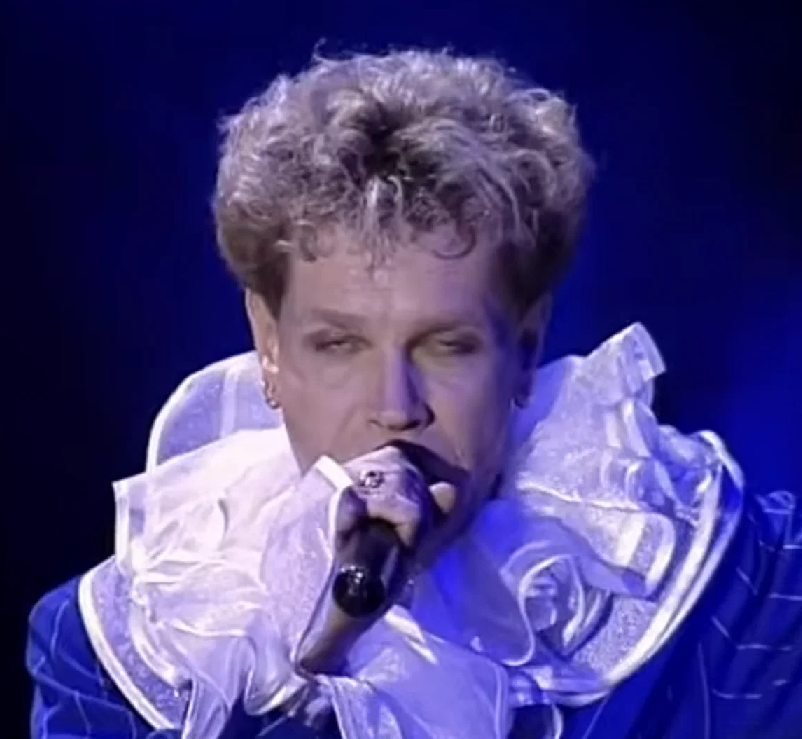
I’m not talking about the Zara Larsson “Blue Moon,” or even the Elvis-recorded jazz standard written by a gay man in the 1920s. This “Blue Moon” came to us in 1998, a collaboration between the late, openly-gay Russian dancer Boris Moiseev—described as “Russia’s answer to Elton John”—and straight songwriter Nicholay Trubach. The lyrics tell a story of forbidden love and desire, enshrining the song as a “taboo-smashing pop hit” and “Russia’s unofficial gay anthem.” In one performance, Moiseev performs in a flouncy, flamboyant outfit, a combination of erotic dancer and sad clown. In telling his own story of ostracization and loneliness, Moiseev’s performance of the song struck a chord.
Before Russia officially banned LGBTQ+ content as “propaganda” in 2013, discussions of queerness were still very much taboo. Moiseev and Trubach’s song tells the story of two brothers, one of whom is described as “голубой,” a word that means “light blue” but also doubles as slang for gay. Perhaps it was the clear risk that made the song such an instant hit, or maybe it was the uncloseted (and then re-closeted) Moiseev’s performance that won over hearts and minds. Whatever the reason, “Blue Moon” is still beloved by the Russian LGBTQ+ community to this day for daring to tell the story of a “strange love” that society doesn’t understand, but doesn’t have to punish.
We don’t know if Moiseev and Trubach were inspired by Lorenz Hart’s 1934 song “Blue Moon,” whose lyrics tell of a similar unrequited love—in an outdoor atmosphere that sounds quite a bit like cottaging (“you saw me standing alone/without a dream in my heart/without a love of my own.”) But we do know that the gays love a moon, blue or otherwise. In 1997, just one year before “Blue Moon,” another Russian singer, Shura, told his own queer story in “Cold Moon.”
Since its debut in 1998, “Blue Moon” has become something of a standard of its own. Moiseev died in 2002, but other Russian singers have put their own spin on the classic, including “Cold Moon” singer Shura—but nothing comes close to the risks the original took in bringing a story of light blue love to the mainstream.
Source: https://www.queerty.com/apparently-russia-has-an-unofficial-gay-anthem-and-its-not-the-one-you-think-20261022/


