
By James Felton
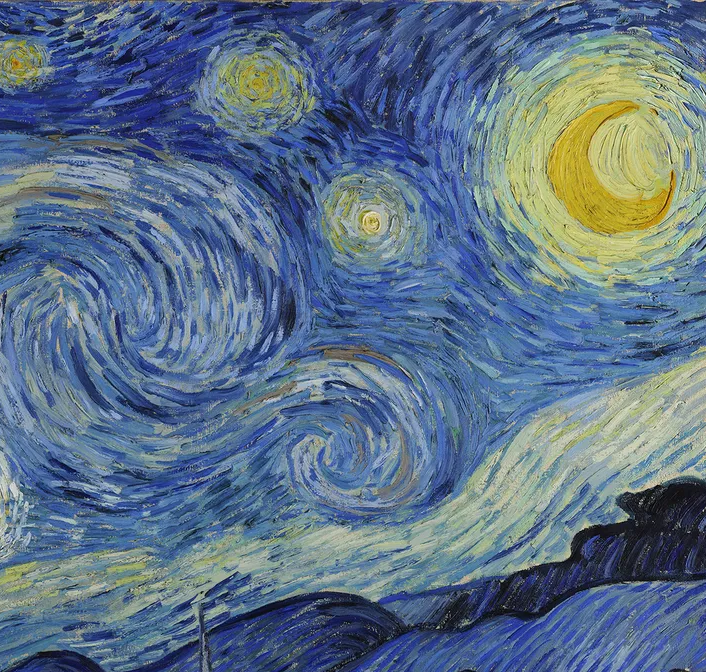
A new study claims to have solved a mystery about Vincent van Gogh’s painting The Starry Night, and has even identified the exact night that it was inspired by.
Van Gogh’s The Starry Night is undoubtedly one of the world’s most famous paintings, way up there with Van Gogh’s Sunflowers and that painting from the Mr. Bean movie. It has been studied by art historians extensively, and yet mysteries remain.
One is whether it depicts a real night sky seen by the artist or whether it was a fantasy composition. This feeds into another query, which asks exactly what night The Starry Night depicts.
Other teams have attempted to solve this before, and there are a few clues to help them.
Does The Starry Night show a real night?
Clues to the question can be found in van Gogh’s letters, which help date the painting’s inspiration to the summer of 1889, and another is the stars and Moon depicted in the painting itself.
Assuming that these are astronomical observations and not fantastical creations, it should be possible to figure out what night the painting was inspired by.
Unfortunately, previous teams have come up with conflicting results. Mid-June 1889 has been suggested, but on the proposed date the Moon would have appeared much fuller in the sky than it does in the painting.
Now a new team, from the South Korean space-science company SLLAB Inc. and the School of Space Research at Kyung Hee University, believes that earlier attempts made a key error in identifying which constellations van Gogh was depicting.
“To an observational astronomer, the cluster of stars in The Starry Night is the Hyades in Taurus,” first author Elijah Jeong-hyun Kim, CEO of SLLAB and a Ph.D. candidate at Kyung Hee University’s School of Space Research, said in a statement.
“But the moment I read the earlier studies explaining it as Aries, I heard the painting calling to me.”

Assuming that the painting was depicting the Hyades, the team says that they can therefore date it to the morning of July 22, 1889.
On that date, the Moon, Venus, and the Hyades star cluster in the constellation Taurus would all have been visible around dawn. The Moon would have been fuller, too, more closely matching the painting.
Meanwhile, they rule out the previous June date on the grounds of Venus and Aries not being visible at the same time in the twilight sky.
Back to the source
As well as traveling to Saint-Rémy to check that van Gogh’s perspective would have allowed for viewing the proposed constellations, the team found further support for the July date in letters from van Gogh which mentioned cicadas. This suggests that the weather was hotter, more typical of July of that year.
Weather reports from the time also indicate that the sky would have been clear on the newly proposed date, though the team stresses that the painting could be based on several nights of observation merged into one final painting.
While for some knowing the exact date is the important bit of all this, the team was more excited to have evidence that the painting is based on observation rather than fantasy.
“The core of the scenario this study has narrowed down is not the date itself but the fact that mutually independent constraints — the narrow-FOV [field of view] frame, the shape of the central asterism, the positions of the Moon and Venus, the contemporary weather, and the seasonal descriptions in the letters — converge together on a single dawn in late July 1889,” the team write in their study.
“This convergence of unrelated layers pointing to the same moment is hard to reconcile with the premise that the sky on the canvas is an arbitrary creation; reading it instead as rooted in the experience of observing a celestial arrangement that actually existed on a particular dawn becomes the simplest explanation.”
The study is published in Scientific Reports
Source: https://www.iflscience.com/forensic-astronomy-may-have-solved-a-mystery-about-van-goghs-the-starry-night-85004


